
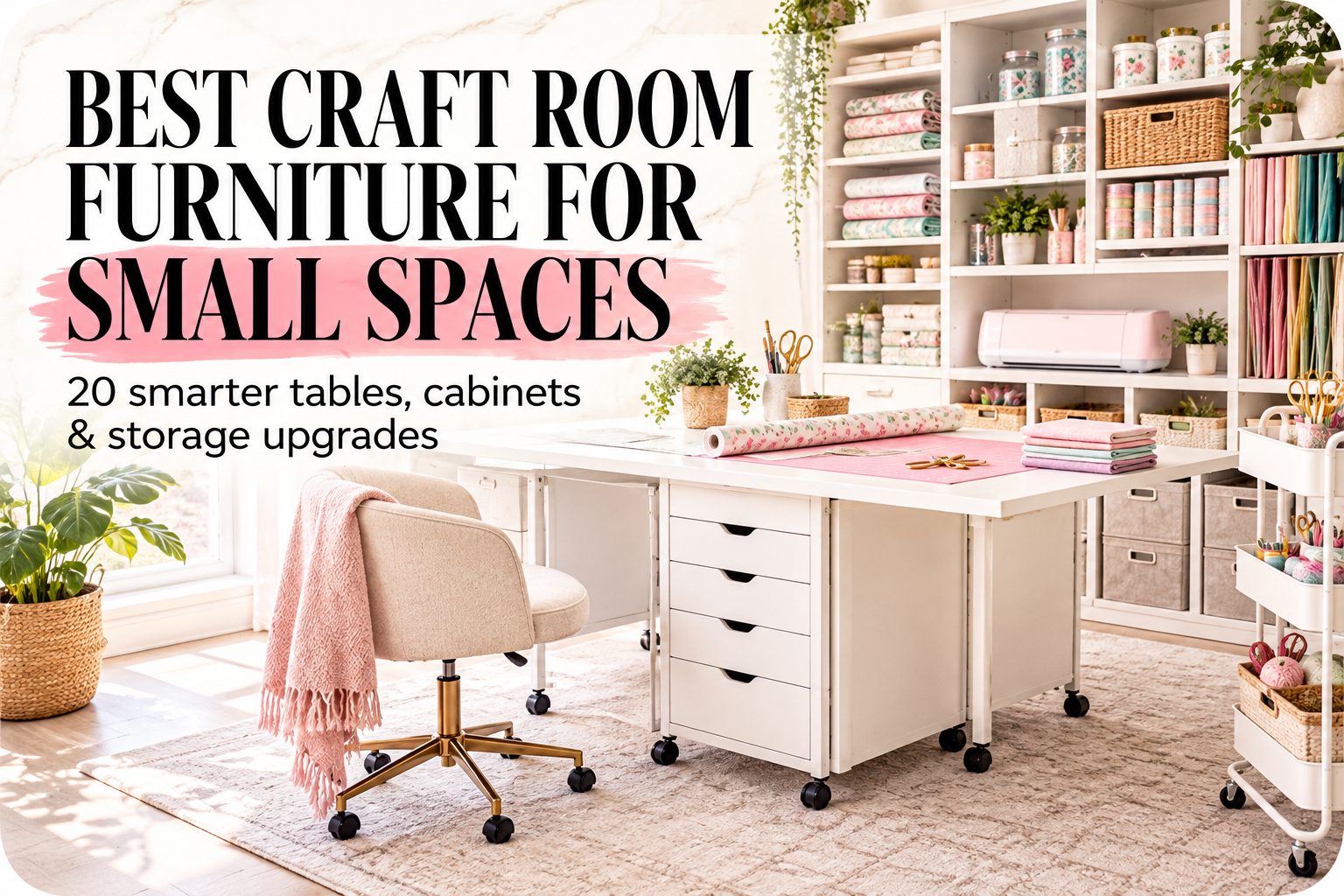
Best Craft Room Furniture for Small Spaces: What Makes a Good Buy?
You know that moment when you sit down to make one tiny thing and suddenly the dining table looks like a craft store exploded? Same. The good news: you do not need a Pinterest-perfect spare bedroom to have a craft room that actually works. A guest-room corner, a wall in your home office, or a rolling station beside the kitchen can be plenty. The trick is choosing furniture that gives your supplies a home without making the rest of your home feel like a permanent work-in-progress.
We rounded up twenty craft tables, sewing cabinets, rolling carts, and clever storage pieces for the kind of space real people actually have. Some are investment pieces; others are the practical sidekicks that keep scissors from disappearing into another dimension. The goal is not to convince you that you need all twenty (please do not buy twenty cabinets). It is to help you find the one or two upgrades that solve your most annoying craft-room problem, so your money goes toward more making and less rearranging.
Interest in dedicated hobby spaces is growing. TaskRabbit’s 2026 report described a 33 percent year-over-year rise in craft room projects, while Michaels reported increased interest in skill-building hobbies and sewing. Those signals make this an appealing category to cover, but they are not evidence that any one product is currently trending, highly rated or in stock. We have not personally tested every item, and shoppers should check the current listing.
There is no universal best craft-room setup, because a quilter wrestling with yards of fabric needs something very different from a Cricut fan surrounded by vinyl rolls. And someone who makes greeting cards? They probably just want their paper to stop curling in a mystery pile. We will match furniture to the way you actually craft, point out the measurements worth checking, and flag the trade-offs that glossy product photos tend to skip. Think of this as shopping with a practical friend who brought a tape measure.
The Five Things to Check Before You Buy Craft Furniture
Before a cute cabinet talks you into clicking Buy, grab a tape measure. Check the wall, the floor, the doorway, and the space your chair needs to scoot back. Folding tables are especially sneaky: they look tiny when closed and then unfold like they have plans to take over the room. Mark the open footprint with painter’s tape and try walking around it. If you have to shuffle sideways holding a rotary cutter, that is your answer.
Next, measure the actual things you will put on or inside the furniture. A sewing machine needs room for fabric to travel; a cutting machine needs clearance for mats; and both need space for cords and access. Interior shelf measurements matter much more than the outside dimensions printed in a listing. If the cabinet is tall, think about stability and the manufacturer’s anti-tip instructions. If it rolls, check the brakes and whether it is designed to stay steady while equipment runs. Cute is great; wobbling is not.
A dozen drawers sounds impressive until you realize none fits your scrapbook paper. Match the storage to your supplies: shallow slots for flat sheets, deeper bins for yarn and fabric, divided drawers for tiny notions, and proper holders for vinyl rolls. Think about what you reach for every single session and keep those items easiest to grab. Before committing to a large piece, read recent reviews about assembly, shipping damage, and the return process. Returning a giant flat-pack cabinet is nobody’s idea of a relaxing craft night.
| Your priority | Best furniture type | Check first |
|---|---|---|
| More cutting space | Folding cutting table | Open footprint |
| Hide a full collection | Craft armoire | Door clearance |
| Organize vinyl and cutters | Machine-specific cart | Machine and mat fit |
| Control little components | Drawer cabinet | Interior drawer size |
Best Folding Craft Tables and Sewing Workstations

If every creative session begins with clearing breakfast dishes, a dedicated work surface may be your biggest quality-of-life upgrade. A folding cutting table offers temporary elbow room; a sewing cabinet gives you a more furniture-like home base. Neither is automatically better. Ask yourself whether you need a generous surface for spreading things out or a tidy piece that disappears into the room when company comes over. Then check the open dimensions, working height, and how stable the surface feels for your kind of project.
Quilters and fabric cutters, this is your permission slip to stop trying to cut patterns on the floor. A height-adjustable table with folding wings can make big layouts much easier and may save your back from a marathon of bending. But measure the fully opened table, not just the neat little footprint shown folded up. Make sure you can circle it comfortably, reach across it, and lock the wheels as directed. A big surface is only a win if you can actually use all of it.

BEST FOR LARGE FABRIC LAYOUTS
Sew Ready Hobby & Cutting Grid Table
An adjustable-height cutting table with folding wings is a logical first choice for quilters, pattern cutters and people making oversized paper projects. It trades cabinet-like concealment for temporary working area.
A small thank-you: this link supports our business.
As an Amazon Associate I earn from qualifying purchases. These links may earn Catching Print Co. a commission at no extra cost to you. Product prices, shipping, stock and ratings can change; confirm all details on Amazon.
For the person who crafts three evenings a week and is tired of rebuilding their setup each time, a substantial worktable with drawers and shelves can feel like a promotion. Tools stay nearby, your work surface stays ready, and projects have somewhere to pause. The trade-off is that this furniture wants a permanent address. Measure the reach across the top, check how far drawers open, and leave room behind machines for cords and materials. Spend more for daily convenience, not just because the cabinet looks expensive.

BEST PERMANENT PREMIUM WORKTABLE
Sauder Craft Pro Series Work Table
A broad, furniture-style work surface with integrated drawers and shelving for people who work on creative projects most days. Choose this type when leaving materials out is more useful than repeatedly folding everything away.
A small thank-you: this link supports our business.
A folding, rolling table is the craft-room equivalent of having a guest bed that only appears when you need it. Spread out fabric, wrap orders, or tackle a giant paper project, then fold the surface back when normal life resumes. That flexibility is especially handy in a shared room. Just remember to check the folded width, how the leaves are supported, and the caster locks. If it takes a full workout to unfold, you may find yourself avoiding the projects you bought it for.

BEST PACK-AWAY CUTTING SURFACE
Sew Ready Folding Adjustable-Height Cutting Table
This rolling, folding table format is useful for a home where fabric cutting or packaging occasionally takes over a shared room. You get extra surface when it is required without committing to a permanent large workstation.
A small thank-you: this link supports our business.
Want your sewing supplies to live in the living room without announcing themselves to every visitor? A wood-look rolling craft cart can be a good compromise. Closed doors conceal the thread, fabric, and half-finished projects; an expandable top gives you more space when inspiration strikes. Check the interior shelf dimensions against your machine and storage bins, and make sure the doors have room to open where you plan to park it. A beautiful cabinet is less useful if you have to move the sofa to get inside.

BEST FURNITURE-LOOK SEWING CART
Sauder Craft Cart with Expandable Top
A rolling wood-finish craft cart is easier to integrate into an existing living space than a bare steel utility table. Doors, shelves and a drop leaf help keep sewing supplies collected when the hobby pauses.
A small thank-you: this link supports our business.
A folding sewing table makes sense for people who love sewing but do not want their entire home decorated in bobbins. You get a real work area when it is time to make something, then a smaller footprint afterward. Check the table height against your chair, look closely at where the machine will sit, and make sure there is enough knee room. A few inches can make the difference between a relaxing afternoon and spending the evening hunched over like a question mark.

BEST OCCASIONAL SEWING STATION
VIVOHOME Folding Sewing Table
A folding sewing table is often enough when a dedicated studio is out of the question. It offers a temporary place to work, with the possibility of rolling or storing it between projects.
A small thank-you: this link supports our business.
If you want your thread, scissors, and sewing machine to travel together, a folding table with built-in trays and shelves is worth a look. The appeal is simple: open it, craft, close it, and regain the room. Check the shelf configuration, caster hardware, and whether the open tabletop suits your projects. Also think about the things you leave in the trays: nothing ruins a tidy fold-away setup faster than discovering your favorite supplies have nowhere to go when the doors shut.

BEST FOLD-AWAY CRAFT WORKSTATION
Best Choice Products Large Folding Sewing Table with Storage
This large folding sewing and craft table has a broad work surface, built-in storage trays, adjustable shelving, magnetic doors and rolling casters. It folds down into a smaller cabinet when the creative chaos needs to disappear. Check the selected color, measurements and current Amazon availability before ordering.
A small thank-you: this link supports our business.
Best Craft Storage Cabinets and Armoires

A cabinet with doors is wonderful when your craft space doubles as a guest room or home office. One minute it is a colorful supply headquarters; the next, the doors close and the room looks suspiciously organized. The catch? Armoires are big, often heavy, and not exactly a spontaneous Saturday assembly project. Map out the door swing, any pull-out work surfaces, and the delivery path before you order. You want storage that hides the mess, not furniture that blocks the closet.
A full-size craft armoire is for the maker whose supplies have officially outgrown the cute basket phase. It can hide a serious collection and give a shared room a calmer look, which is a genuine benefit if clutter stresses you out. But do not judge one by the closed-door photo alone. Look for the open configuration, measure the shelves, and check how any fold-down or slide-out work area is supported. The real question is whether it makes starting a project easier.

BEST HIGH-TICKET CONCEALED STUDIO
Sauder Harbor View Craft & Sewing Armoire
This tall, enclosed furniture format is a splurge for people who need their craft collection behind doors. It can make a multipurpose room feel finished rather than permanently mid-project.
A small thank-you: this link supports our business.
Sewing supplies have a talent for migrating: needles in one drawer, thread in another, scissors somehow in the bathroom. A sewing armoire can bring the essentials back into one place. It is particularly useful when you sew often but cannot leave a machine out permanently. Check the usable machine shelf and work surface, not just the cabinet’s overall height. And make sure the open doors and moving panels will not collide with your chair or nearby furniture.

BEST DEDICATED MACHINE STORAGE
Sauder Sewing & Craft Armoire
A sewing-oriented armoire can keep related supplies near the machine and reduce the amount of equipment migrating around the house. It makes sense if your hobby is frequent but the room still needs another purpose.
A small thank-you: this link supports our business.
When floor space is precious, going vertical can feel like finding extra square footage. A tall craft cabinet gives bins, folded fabric, and lighter supplies a place to live without sprawling across the room. Put heavy materials low, frequently used supplies at comfortable reaching height, and the rarely touched seasonal stash up top. Label the bins unless you enjoy opening six identical boxes to find one glue gun. Follow the manufacturer’s anchoring and load guidance, especially in a busy household.

BEST USE OF VERTICAL SPACE
NEWOWNDS Tall Craft Cabinet with LED Lighting
A tall shelving cabinet makes use of the wall height when floor area is scarce. It is most valuable for stacked bins, paper and lightweight components that would otherwise sprawl across multiple surfaces.
A small thank-you: this link supports our business.
Cricut and other cutting-machine owners know the particular chaos of vinyl rolls, mats, tools, and tiny accessories. A dedicated station can bring that whole traveling circus together. The most useful features are the ones that fit your actual machine and materials: a clear feed path, storage for flat mats, and roll holders you will use. Measure your cutter with its lids open and account for the mat moving through it. A clever-looking organizer is not clever if it blocks the machine.

BEST MACHINE-SPECIFIC ORGANIZATION
LOPASA Cabinet for Cricut Supplies
A dedicated cutting-machine cabinet is designed around the frustrating details: rolls, mats, paper and small tools. That specialization can be worthwhile when those exact materials dominate your crafting.
A small thank-you: this link supports our business.
Here is a little craft-room secret: furniture sold as pantry storage can be excellent craft storage, too. Adjustable shelves do not care whether they hold cereal boxes or neatly labeled bins of embroidery floss. This can be a smart way to get concealed storage without paying extra for a craft-specific label. Check shelf strength, interior depth, and whether the door racks work for your materials. And do not assume a general cabinet is suitable as a powered machine workstation.

BEST FLEXIBLE SHELVES BEHIND DOORS
Gizoon Pantry-Style Cabinet
A standard pantry-style cabinet can be a clever substitute for expensive specialty craft furniture, especially if your supplies already live in labeled boxes. Adjustable shelves provide flexibility as projects evolve.
A small thank-you: this link supports our business.
Best Rolling Craft Storage Carts
Rolling carts are the unsung heroes of small craft spaces. They can follow you from closet to desk to dining table, then politely disappear when dinner is ready. The best cart is not necessarily the one with the most compartments; it is the one that fits your supplies, moves smoothly, and stays put when parked. Check wheel locks, weight limits, and the top’s stability. If you are loading it with heavy equipment, verify the manufacturer actually intends it for that use.
A cutting-machine cart can save you from the familiar pre-project scavenger hunt: Where is the scraper? Where did the mat go? Why are there three rolls of the same pink vinyl? Giving the machine and its accessories one home makes crafting feel easier before you even press Start. Measure the machine, its mat-feed clearance, and the storage openings. Leave enough room to reach tools without pulling the entire cart apart.

BEST MOBILE CUTTING-MACHINE SETUP
GDLF Rolling Craft Cart for Cricut
A dedicated rolling station can give a vinyl cutter and its materials one predictable home. This avoids starting every project by hunting for mats, blades, pens and rolls in three separate closets.
A small thank-you: this link supports our business.
If your vinyl rolls are currently stacked in a basket like colorful pool noodles, a roll-organizing cart could be a game changer. Being able to see colors at a glance makes planning projects faster and helps you avoid buying a shade you already own. Count your rolls before shopping and leave a little breathing room for the collection to grow. Check the holder diameter and whether rolls are easy to remove individually. Storage should make the fun part faster, not become a puzzle.

BEST FOR LARGE VINYL COLLECTIONS
CXQ Cart with Vinyl Roll Storage
A roll-focused cart can be more useful than another drawer cabinet if your biggest frustration is seeing and selecting colors. Dedicated holders let you put rolls away without burying them in boxes.
A small thank-you: this link supports our business.
Eight drawers can sound like eight tiny miracles when your craft supplies are scattered across three rooms. Give each one a job: adhesive, ribbon, embellishments, tools, current projects, and whatever else makes sense for your hobby. A rolling cart is particularly useful when you move between work areas. Just be realistic about what it can carry. Lightweight drawers are terrific for supplies, but not every cart is meant to hold a heavy sewing machine.

BEST COLORFUL MIXED-SUPPLY CART
SYKIARIOL Eight-Drawer Rolling Cart
Multiple drawers are ideal when supplies divide naturally into categories such as ribbons, adhesives, cutouts and active projects. A utility cart can also accompany your work into another room.
A small thank-you: this link supports our business.
Sometimes four roomy drawers beat twelve little ones. If you store bulky tools, fabric scraps, yarn, or boxes of materials, deeper compartments can be much less frustrating than a maze of shallow trays. Look at the interior measurements and think through what goes where before buying. Check how the drawers slide when full and whether the wheels lock. A cart should help you find things faster, not create four new junk drawers.

BEST FOR BULKIER MIXED SUPPLIES
Aokitsink Four-Drawer Metal Cart
A cart with fewer, deeper drawers can be easier to manage than a grid of dozens of tiny compartments. This is a sensible direction for larger tools, fabric scraps and boxed materials.
A small thank-you: this link supports our business.
Clear drawers offer a wonderfully simple benefit: you can see what you own. That matters when you have a habit of buying yet another packet of clips because the first three are hiding somewhere. Transparent storage is great for smaller supplies and categories that stay relatively consistent. The trade-off is that everything is on display, so it may look busy in a shared room. If visual calm matters more than instant visibility, opaque drawers and labels may suit you better.

BEST VISUAL SUPPLY INVENTORY
WOPITUES Ten-Drawer Clear Cart
Clear drawers help with the classic craft-store problem of buying another pack of something already at home. Visibility is the principal advantage when your categories are small and fairly consistent.
A small thank-you: this link supports our business.
Best Compact Drawer Cabinets and Small-Parts Storage
Once your main table is sorted, drawer storage is where the magic happens. Not glamorous magic, exactly—more like finally knowing where the good scissors live. Shallow drawers are great for flat paper and little tools; deeper ones work better for chunky supplies. Resist the urge to shop by drawer count alone. Decide what you want to store first, then check the usable interior dimensions. Your future self, looking for a missing ruler at 11 p.m., will appreciate the effort.
A white rolling cabinet can blend nicely into a home office while keeping everyday craft tools close enough to reach without standing up. It is a good fit for people who switch between work and creative projects at the same desk. Measure the space under or beside your desk, including room to pull drawers all the way out. Check the interior dimensions, caster design, and assembly requirements. Bonus points if it keeps the desktop from becoming a permanent landing strip for supplies.

BEST COMPACT FURNITURE-STYLE DRAWERS
DEVAISE Five-Drawer White Storage Cabinet
A white rolling drawer unit can blend into a studio-office setup and keep tools, labels or paper categories close to the work surface. It is most useful when the contents are regularly reached for.
A small thank-you: this link supports our business.
A tall, narrow drawer unit is useful when you have lots of small categories but not much floor space. Think stickers, card blanks, cutting tools, pens, and the little pieces you swear you will organize later. Give each drawer a purpose and label it from the start. Otherwise, seven drawers can turn into seven places to lose the same thing. Check the usable depth and whether the unit rolls smoothly in the spot where you plan to keep it.

BEST VERTICAL DRAWER ORGANIZATION
DEVAISE Seven-Drawer Mobile Cabinet
Separate shallow drawers can support a simple category system for writing supplies, cutting tools, stickers and unfinished paper projects. The vertical format keeps the footprint smaller than a wide dresser.
A small thank-you: this link supports our business.
Buttons, beads, charms, fasteners, and tiny sewing notions have one thing in common: they vanish when you need them. A small-parts cabinet makes it easier to keep those pieces sorted and visible. It is a supporting player, not a replacement for a worktable or larger storage. Check the drawer sizes, decide how you will label categories, and follow the mounting or placement instructions. This is the kind of modest upgrade that can save surprising amounts of project time.

BEST FOR TINY HARDWARE AND FINDINGS
IRIS USA 44-Drawer Parts Cabinet
Small drawers shine for charms, fasteners, buttons and other easy-to-lose materials. A compact parts cabinet is an efficient secondary purchase for a hobby with many small components.
A small thank-you: this link supports our business.
A rolling multi-drawer cart is especially handy if your hobbies rotate with the seasons. One month it is paper flowers; the next it is holiday cards; suddenly you are deep into embroidery. Keep a few drawers for permanent essentials and use the rest for active projects. That way you are not reorganizing your entire room every time inspiration changes direction. Check drawer dimensions and wheel quality, and be realistic about how much weight you will put inside.

BEST FOR PROJECT-BASED ORGANIZING
neatevday Eight-Drawer Rolling Cart
A movable multi-drawer cart can support a changing craft rotation. Instead of collecting materials by type forever, dedicate a few drawers to active projects and reset them when you finish.
A small thank-you: this link supports our business.
Three Small Craft Room Layouts That Actually Work

One-wall creative station
Working with one spare wall? Start with the table, not the accessories. Put your most-used tools within easy reach, then add a narrow cart or shelves for everything else. Leave room to move your chair and open drawers fully. If you cannot comfortably sit, stand, and grab a tool, the layout is too tight. A small room should feel like a creative shortcut, not an obstacle course.
Closet materials library
A closet can become an excellent supply library, even if it is not the right place to operate a machine. Group materials into labeled bins, keep heavy items low, and reserve the easy-to-reach shelves for things you use all the time. Seasonal projects can live higher up or farther back. The goal is to open the door and know exactly where everything is, rather than being greeted by an avalanche of mystery bags.
Shared dining-room setup
If your dining table moonlights as a craft studio, make cleanup part of the setup. A rolling cart with a designated parking spot or a folding worktable can help you switch from project mode to dinner mode without drama. Keep works-in-progress in one tray or box so you can pick up where you left off. The dream is not a spotless house every second; it is being able to put away a project in five minutes instead of forty.
Questions Buyers Ask Before Spending More
Is a more expensive craft table worth it?
It can be when the extra money buys a genuinely larger stable surface, easier movement, durable hardware or storage you use every session. But premium furniture is poor value when it merely matches a design aesthetic. Buy against the specific interruption you want to remove: lack of cutting space, too many supply piles, or nowhere to put away a machine.
Should I choose a sewing armoire or a storage cart?
Choose an armoire when you have a permanent wall location and want the supplies concealed. Choose a cart when you change work locations and value mobility. Armoires typically involve greater assembly effort and need door clearance; carts offer flexibility but may have less capacity and stability for heavy equipment. Neither choice is inherently better without knowing the room.
What kind of craft storage fits a Cricut machine?
A machine-specific cabinet is attractive because it may combine work surface, paper storage, mat clearance and vinyl-roll organizers. The exact fit depends on your particular model, accessories and the way materials feed through the cutter. Check those details with the dimensions in the selected Amazon listing instead of relying solely on broad compatibility claims.
Can I use ordinary office or pantry furniture?
Yes. Simple drawers and adjustable shelves often work well for paper, tools, yarn and neatly boxed supplies. The limitations are weight, ventilation, durability and the shape of the materials. A general-purpose pantry cabinet should not be assumed to serve as a heat-press station or machine support without explicit manufacturer specifications and adequate clearance.
How do I avoid buying furniture that is too big?
Measure the fully opened furniture, not just the packed or folded size. Add space for people to walk, doors to swing, drawers to open and a chair to move. Verify the path through hallways and stairways during delivery. For tall cabinets, follow anchoring instructions, and for heavy furniture make a realistic plan for assembly before it arrives.
The Bottom Line
The best craft room furniture for small spaces is not necessarily the biggest cabinet, the prettiest table, or the item with the most five-star reviews. It is the piece that removes the annoying little hurdle between you and making something. Maybe that is a cutting table that saves your back, a cabinet that closes on the chaos, or a rolling cart that finally keeps your vinyl together. A good purchase makes the next creative afternoon feel like a treat instead of a setup chore.
Here is your shopping game plan: pick the two or three pieces that solve your biggest problem, measure your space, and compare their current Amazon listings side by side. Look at recent customer photos, dimensions, availability, shipping costs, and return policies before checking out. You do not need a complete craft-room makeover in one order. Start with the upgrade you will use most often—and save the rest of your budget for the fun supplies that will inevitably follow.
More ideas: DIY bag charm party · Travel junk journaling · Visible mending · Mini magazines









Leave a Reply