
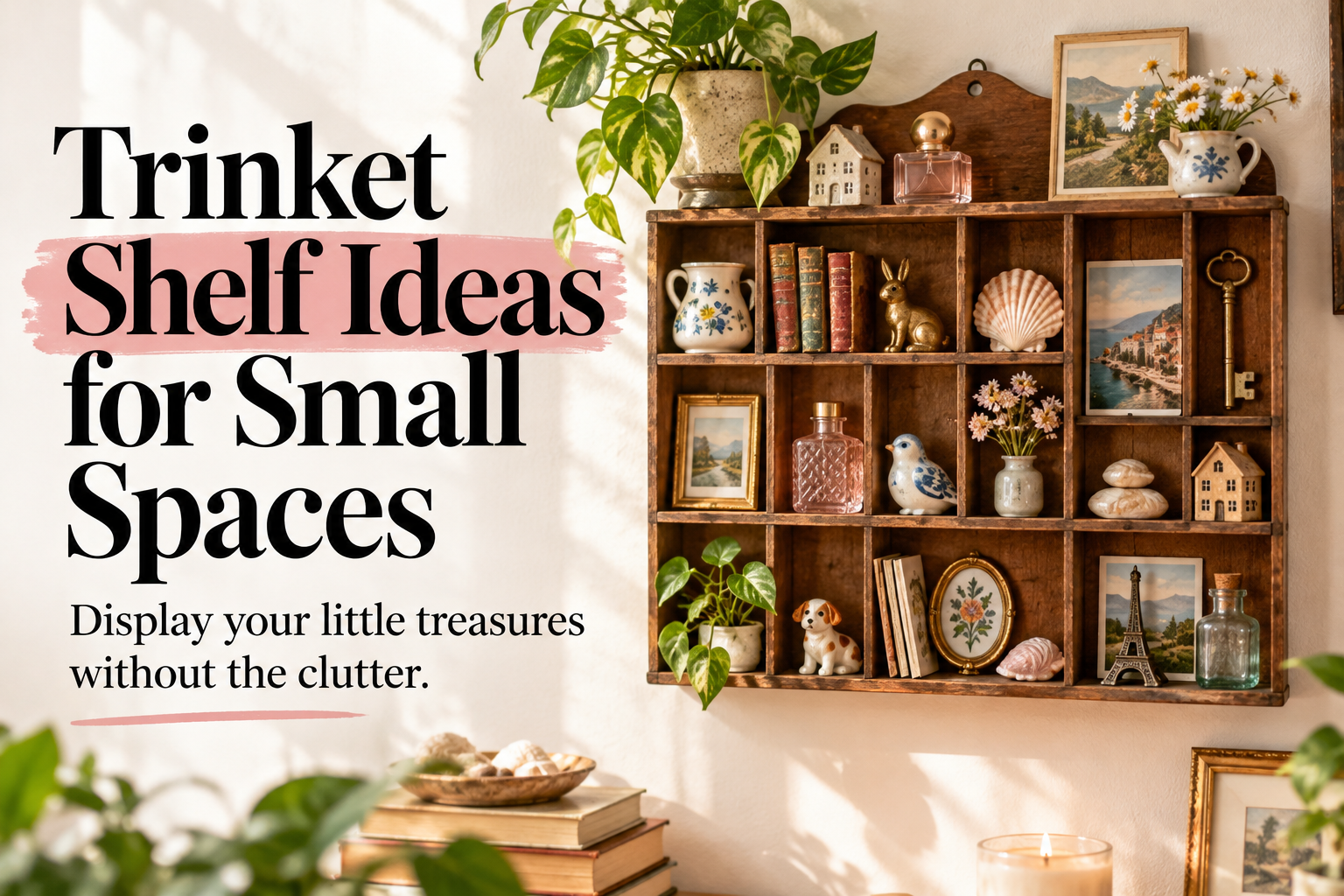
Looking for trinket shelf ideas for small spaces? Some people collect fine art. Some people collect tiny ceramic ducks with deeply expressive faces. Both deserve decent display space. If your home has acquired an army of figurines, sentimental souvenirs, shells, mini frames, and other little things you love, a trinket shelf can turn that collection into the most personal corner of the room.
The trick is not cramming everything onto the first floating shelf you find. A good display solves real problems: precious pieces vanish behind taller objects, small rooms start feeling crowded, fragile collectibles gather dust, and random shelves make a wall look busier than the collection itself.
Whether you love eclectic vintage decorating, collectible figures, nostalgic souvenirs, or the growing curated-clutter aesthetic, this guide covers how to choose a shelf, arrange your objects, handle lighting and dust, and make the whole setup feel intentional. There are specific supplies worth considering, but you do not need to buy all ten to make something lovely.
We’ll start with your actual collection and space, because that’s where the useful decisions happen. The shopping suggestions appear only where a real design problem calls for them. By the end, you should know exactly what belongs on display, what can rotate in later, and how to avoid turning your apartment into a very charming but unwalkable museum.
As an Amazon Associate I earn from qualifying purchases. Some links in this article may earn Catching Print Co. a commission at no extra cost to you. Thanks for supporting our work. Confirm current prices, variants and availability on Amazon.
Quick guide: which trinket display actually fits your space?
Short on time? Here is the cheat sheet. You don’t need a dozen matching shelves or a suspiciously large budget—just a display that fits your treasures and your actual room.
- For tiny figurines: clear acrylic risers make the back row visible without crowding the front.
- For a small apartment wall: shallow floating shelves or picture ledges keep your floor space free.
- For dust-prone collectibles: an enclosed display case gives your miniature collection a little less housekeeping.
- For sentimental photos and tickets: a shadow box keeps a story together in one neat frame.
- For renters: choose a secure tabletop setup first; use adhesive ledges only within the manufacturer’s surface and weight guidelines.
Start with the objects you already love, check their weight and dimensions, and then choose the lightest, simplest display that works. The rest of this guide gets into the fun details, including easy arrangements, renter-friendly options, dust control, and a few things not to put above your bed.
Start with a trinket shelf display that feels like you
Some homes have a neatly arranged gallery wall. Others have a ceramic frog from a road trip, three tiny cats, a rock with an excellent backstory, and a shell whose official provenance is “that beach, probably.” If your belongings lean toward the second category, welcome. The goal is not to pretend you own fewer interesting things. It is to make the things you love look like they belong together.
The best trinket shelf ideas begin with a different question from “What should I buy?” Ask what you want to see when you enter the room. Is it your grandmother’s miniature pitcher collection, little souvenirs from trips, a handful of collectible figures, or an eccentric mix of objects that all remind you of people? Pick the feeling first. The shelf is simply the supporting cast.
The aesthetic sometimes gets called curated clutter, but “curated” is doing a lot of work there. A good display has a boundary, a rhythm, and enough breathing room that your eye can land on individual objects. You can absolutely love maximalism without arranging every possession as if it has been summoned to a very small town hall meeting.

FOR A CLEAN WALL DISPLAY
BAYKA Black Floating Shelves — Set of 3, 15.7 Inches
Three matching wall shelves let a collection occupy one deliberate zone instead of migrating across every surface. Check wall type, supplied hardware and the current weight rating before installing.
VIEW ON AMAZONA small thank-you for supporting Catching Print Co.
How to choose trinket shelves for small spaces
Small-space decorating is mostly geometry wearing cute shoes
Before shopping for a display shelf, grab a tape measure and write down the width, height, and depth of the space. Include the clearance needed to reach nearby switches, open doors, and sit at furniture. A shelf that looks adorable in a product photograph becomes less adorable when it prevents a closet door from opening all the way.
Depth matters especially for trinkets. A narrow picture ledge works beautifully for postcards and tiny framed prints but may not safely hold a deep figurine or little vase. Measure your largest object from front to back, add a little room for fingers and stability, and then compare that number with a shelf’s usable depth rather than its overall dimensions.
If you are mounting shelves above a work area, avoid placing anything heavy, breakable, or sharp where it could fall onto a person. Find the wall studs where appropriate, identify the wall construction, and use hardware suitable for both the shelf and the wall. Manufacturer capacity claims often depend on specific mounting conditions; decorative confidence is not a substitute for fasteners.

FOR THE TINY OBJECTS IN THE BACK
NIUBEE Clear Acrylic Display Risers — Two Sets of Three
Clear risers bring smaller figurines and curios above the front row so you can actually see them. Measure the shelf depth and the tallest item before choosing riser dimensions.
VIEW ON AMAZONA small thank-you for supporting Catching Print Co.
Use acrylic risers to display small collectibles at different heights
Miniatures have a visibility problem. Arrange five small treasures in a straight row and the objects at the back vanish, usually just after you have carefully dusted them. Think of your shelf like a tiny theater: taller pieces belong toward the rear, smaller pieces near the front, and everyone deserves a reasonably clear view.
Acrylic risers make this easy, but books, sturdy boxes, or a shallow overturned bowl can do the same job if their weight and stability make sense. The important detail is that the platform is flat and secure, not that every level has been purchased from a specialist collector’s store. Try a small height change first; a dramatic three-story structure is rarely necessary for six little figurines.
Use a triangular arrangement when you are stuck. Put one taller item near the back, a medium-height object slightly forward, and a small item toward the opposite side. The uneven silhouette feels intentional without turning your shelf into a formal symmetrical parade. Repeat that logic loosely across the display rather than making identical triangles everywhere.

FOR A LIGHT, OPEN LOOK
upsimples Clear Acrylic Wall Shelves — Six-Pack, 15 Inches
Acrylic ledges create visible storage for lightweight collections without adding another heavy-looking piece of furniture. Use the appropriate mounting method for your wall and items.
VIEW ON AMAZONA small thank-you for supporting Catching Print Co.
Clear acrylic shelves vs. wood shelves: which looks better?
An acrylic shelf almost disappears against a light wall, which makes it useful when your figurines and colorful keepsakes are supposed to do all the talking. A dark or wooden shelf has more visual presence; it can make an eclectic collection feel like a deliberate piece of furniture. Neither is automatically better. It depends on what the wall and your objects need.
Transparent shelving is especially helpful in rooms where big, solid furniture would make the space feel closed in. It can also look slick with colorful character figures, small plants in lightweight pots, or a rotating collection of miniature art. The trade-off is that dust, fingerprints, and mounting hardware may be more visible. A microfiber cloth should have a permanent audition for this shelf.
Wooden shelves work well when the objects already contain natural textures: little pottery pieces, brass animals, beach finds, tiny vintage frames, or family souvenirs. A warm wood finish can make unrelated materials feel a little more cohesive, while black can help bright items pop against a pale wall. If you want a less busy look, choose one shelf color and repeat it.

FOR PAPER MEMORIES
Americanflat Front-Opening 11 × 14 Shadow Box — Black
A front-opening shadow box offers a contained place for tickets, pins, and small keepsakes. Confirm internal depth and backing compatibility before arranging anything irreplaceable.
VIEW ON AMAZONA small thank-you for supporting Catching Print Co.
Shadow box display ideas for photos, tickets, and keepsakes
Because the ticket stub deserves better than a random drawer
Not every keepsake wants to stand upright on a shelf. Concert tickets, postcards, pins, small fabric pieces, old recipes, and handwritten notes do better in a framed composition. A shadow box can tell a compact story with a handful of related pieces instead of creating another pile of paper you promise to organize someday.
Try using a simple theme: one trip, one person, one concert, or one era. A little museum-style label written in your own words adds more meaning than another decorative quote. The date, place, or name can be enough. For example, a postcard, a train ticket, and a tiny pressed souvenir tag might tell the story of a weekend more convincingly than a dozen interchangeable travel-themed ornaments.
Before pinning or gluing anything important, consider whether it is replaceable. Photographs, vintage paper, and valuable memorabilia need more careful materials and handling than ordinary decorative paper. Use reproductions for direct attachment when possible, keep originals separate if they are fragile, and consult preservation guidance for special items. The most sentimental piece should not become your practice run with hot glue.

FOR A FLEXIBLE DISPLAY
Command Picture Ledge — Slate, 21 Inches
A removable-adhesive picture ledge is a practical alternative when drilling is not allowed. Follow the manufacturer’s surface-preparation, load, cure, and removal instructions.
VIEW ON AMAZONA small thank-you for supporting Catching Print Co.
Renter-friendly trinket shelves without drilling: what to know
Renters can absolutely make a thoughtful wall display, but “damage-free” is not the same as “works on every wall, under every condition.” Removable mounting products depend on surface type, paint condition, temperature, cleaning method, and weight. Read the manufacturer’s instructions, including the removal process, before you put your favorite breakable bird above a laptop.
A narrow picture ledge can be useful for lightweight framed prints, postcards, and carefully chosen objects. It is less appropriate for dense ceramics or a collection you constantly bump while reaching across a desk. When in doubt, display heavier things on a stable freestanding surface where gravity has fewer opportunities to become part of the storyline.
If your lease prohibits holes, consider a tabletop miniature shelf on a dresser or a small display stand inside an existing bookcase. You can also use the top of a cabinet, provided the furniture is stable and cannot tip. Anchoring tall furniture appropriately is especially important in homes with children or pets, and adhesive decorations should never substitute for furniture safety measures.

FOR THE DUST-SENSITIVE COLLECTION
NIUBEE Clear Acrylic Two-Tier Display Case
An enclosed case can keep miniature figures easier to maintain than an open shelf. Check exact compartment clearances and whether wall mounting is appropriate.
VIEW ON AMAZONA small thank-you for supporting Catching Print Co.
Dustproof display cases for figurines and delicate collections
Open shelves are easy to style and wonderfully accessible. They also collect dust, which can make a detailed figurine or delicate miniature a nuisance to maintain. If cleaning around tiny antennae and fragile painted details feels like a personal attack, an enclosed display case may be worth the extra visual bulk.
An acrylic case is especially useful for small, similarly sized figures, but check the internal measurements carefully. A case that holds a row of short collectibles may not fit taller figures, and what looks like a deep shelf in a marketing image can become surprisingly shallow once the door closes. Write down the largest item’s actual width, depth, and height before ordering.
Choose where the case will live before you buy it. On a desk, it should not block a monitor or natural light. On a wall, it needs mounting support appropriate to the product and the wall. If you are displaying valuable items, remember that dust resistance is not equivalent to theft protection, moisture protection, or museum-quality UV protection.

FOR A DISPLAY WORTH LIGHTING
EZVALO Rechargeable Picture Light — Gold, 16 Inches
An adjustable picture light can brighten a small shelf vignette without permanent wiring. Test placement so delicate objects are not exposed to unwanted heat or intense light.
VIEW ON AMAZONA small thank-you for supporting Catching Print Co.
How to light trinket shelves without glare or fading
A small display looks better when you can see its details. Natural light from the side often does the job beautifully. If the corner is dark, a discreet rechargeable picture light can make a few carefully selected objects feel special without requiring you to reorganize the wiring in your apartment.
Start with warm or neutral light and aim for gentle illumination instead of glare. Shiny ceramics, glossy acrylic, and glass bottles reflect bright bulbs easily. Test the light from your normal viewing position, not just from directly in front of the shelf. A display that looks perfect while you adjust it can produce a tiny spotlight in your eyes from the sofa.
Be cautious with delicate materials. Direct sunlight and prolonged intense light can fade paper, textiles, photographs, and certain finishes over time. Keep irreplaceable items out of direct sun and away from heat. LED lights tend to run cooler than older incandescent designs, but the fixture and its instructions still matter.

FOR LIGHTWEIGHT STABILITY
QuakeHOLD! Museum Putty — Neutral, 2.64 Ounces
Reusable mounting putty may help steady compatible objects on suitable surfaces. Always test an inconspicuous area and avoid valuable, porous, or delicate finishes unless approved.
VIEW ON AMAZONA small thank-you for supporting Catching Print Co.
How to keep small collectibles stable and safe
Small collectibles have a remarkable ability to topple over at exactly the wrong moment. A narrow figurine, lightweight vase, or miniature ornament may need extra support, particularly if the shelf is in a busy hallway or a home where a pet considers furniture placement a collaborative process.
Museum putty and similar stabilizing materials can sometimes help secure compatible objects to suitable surfaces, but they are not suitable for everything. Porous stone, fragile paint, antiques, and delicate finishes can react poorly to adhesives or residues. Check the product’s material guidance and spot-test before placing it under a sentimental or valuable piece.
Stability begins with the shelf itself. Use the proper anchors, keep loads within the actual mounting limits, and place heavier objects lower and farther from the edge. In an earthquake-prone area, follow local safety recommendations; decorative putty is not a substitute for safe furniture anchoring or structural restraints.

FOR A WARMER VINTAGE MOOD
QEEIG Rustic Brown Floating Shelves — Set of 2, 15.7 Inches
A rustic wood-look shelf can visually tie together older ceramics, figurines, and souvenirs. Check the actual finish, installation hardware, and published load requirements.
VIEW ON AMAZONA small thank-you for supporting Catching Print Co.
Vintage trinket shelf ideas with personality, not clutter
Vintage-inspired wooden shelves look especially charming with mixed materials, but there is a fine line between “collected over time” and “gift shop closing sale.” The easiest way to add warmth is not to buy more vintage-looking objects. Start with the real pieces you already own, including the slightly odd ones that make you smile.
Group objects with different textures: a ceramic cat beside a tiny brass frame, a smooth shell next to a rough little stone, or a postcard tucked behind a wooden figurine. Contrast gives the eye something to notice. If everything is the same size, color, and texture, the collection can look oddly flat even when there are lots of pieces.
Try repeating one visual element only two or three times. A small blue detail in several objects can tie a shelf together without requiring every item to match. You can also give an unruly group a neutral backdrop by painting a removable backing board, placing a sheet of decorative paper behind the objects, or using the warm color of the shelf itself.

FOR ONE SMALL STORY
Califortree 8 × 8 Shadow Box with Linen Back — Black
A compact shadow box keeps a mini collection, concert mementos, or a family keepsake grouping together without demanding a whole wall. Avoid pinning through fragile originals.
VIEW ON AMAZONA small thank-you for supporting Catching Print Co.
Budget-friendly trinket display ideas using what you own
Before spending anything, gather all your small collectibles onto a table and sort them into three piles: definitely display, maybe rotate, and better stored safely. This is not a decluttering morality test. It is a way to keep your favorite objects visible instead of turning the entire collection into one loud visual blob.
Next, make a mock display using what you already own. A sturdy book can lift a figurine; a clean tray can establish a boundary for objects on a dresser; a shallow box might act as a temporary riser. Take a photograph and walk away for a few minutes. When you look again, you’ll notice which object draws the eye and which corner feels overcrowded.
If you do shop, prioritize the thing your setup actually lacks. No wall space? A narrow shelf solves more than another ornament. Tiny items disappear? Risers are more useful than a taller display unit. Dust is the main problem? A closed case may be worth paying for. The point is to purchase a solution, not another object that also needs to be displayed.
Set a small budget for the first pass and stop once the display functions. You can always upgrade individual pieces later. Your belongings did not spend years gathering stories just to be upstaged by a coordinating twelve-piece shelf system.
How to style a trinket shelf in 30 minutes
First five minutes: choose your display zone, clear it completely, wipe the surface, and photograph the empty space. This gives you a clean reference and keeps you from automatically placing everything back where it was. If the collection lives on a wall, confirm that the shelves are secure before loading them.
Next ten minutes: choose five to nine pieces that work together by subject, color, or story. Place the largest one first, then the two next-largest items, then fill in with small favorites. Step backward every few minutes. If one object becomes invisible, move it forward or give it height; if one corner shouts, remove something.
Next ten minutes: use the empty space intentionally. Avoid filling every centimeter just because it exists. Leave a little room beside the most intricate object so its details can breathe. Make sure nothing blocks a door, falls off a ledge, or requires awkward reaching. Try viewing the arrangement from the place you normally sit.
Last five minutes: take a photograph, dust the remaining pieces, and put the ones you are not displaying into labeled storage. A small rotation box works brilliantly for this. You’re not rejecting the treasures you store; you’re giving them the chance to have their own moment later. And now you can find that tiny brass duck without conducting an archeological dig.
Trinket shelf FAQs: small spaces, dust, renters, and collectibles
How can I display trinkets without making my room look cluttered?
Choose one bounded display area, group objects by story or visual relationship, vary the heights, and leave visible negative space. Storing part of a collection for rotation is often more effective than buying a larger shelf.
What kind of shelf is best for small collectibles?
A compartment shelf creates natural categories, a floating ledge is useful for lightweight shallow objects, and an enclosed case helps with dust-sensitive figures. The correct choice depends on the size, weight, fragility, and depth of the objects—not just the photograph on the listing.
How do I display trinkets in a rented apartment?
Start with a stable tabletop or bookcase display. If using adhesive-mounted shelves, check the specific product’s surface preparation, capacity, curing, and removal guidance. Do not rely on an adhesive shelf for heavy, sharp, or valuable items.
Should I arrange collections by color or theme?
Either can work. A theme tells a story; color can make visually unrelated objects feel cohesive. For the most personal result, group by meaning first, then make small color and height adjustments.
How do I keep figurines from getting dusty?
Keep a soft cleaning routine, reduce overcrowding, and consider enclosed cases for difficult-to-clean pieces. A closed case may reduce dust exposure, but it still needs occasional cleaning and doesn’t replace appropriate storage for valuable collectibles.
Can I display vintage paper and photographs on a shelf?
Use reproductions where possible, avoid direct sunlight, and be careful with tapes, adhesives, and framing materials that may damage originals. For meaningful heirlooms, refer to professional preservation guidance before mounting.
Your shelf should look like you live there
The best thing about collecting little treasures is that they do not need to be fashionable to be meaningful. The tiny souvenir you bought on a rainy vacation, the figurine you had as a kid, and the shell you carried home in a pocket are allowed to sit in the same room. A thoughtful shelf simply gives them a common stage.
Buy the few tools that solve real problems, skip the rest, and resist the urge to make your home look like a stock photograph. A slightly strange, genuinely personal collection will always be more interesting than decor that has never been anywhere or meant anything to anyone. Display it proudly. Just maybe give the ceramic frog a little breathing room.
If this project gets you in the mood to display more meaningful mementos, our guide to organizing inherited family photos has a gentler way to preserve the things you cannot easily replace. And if you want more hands-on inspiration, take a look at our DIY bag charm party guide for making tiny objects with personality.
Further reading: Always follow the shelf and mount manufacturer’s current directions. This guide focuses on practical display choices, not claims that a product was personally tested.




Leave a Reply