
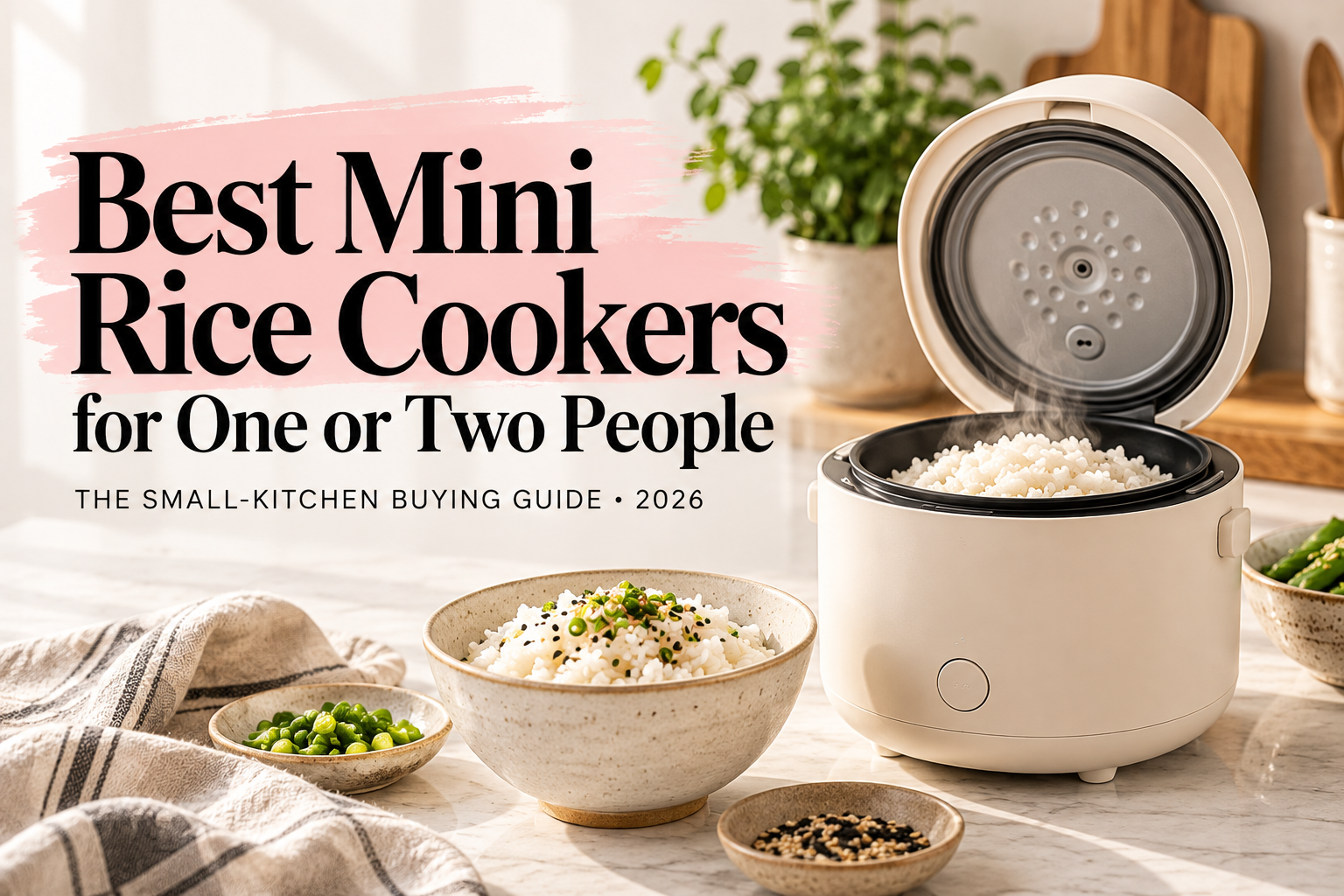
MINI RICE COOKERS · THE SMALL-KITCHEN BUYING GUIDE
Small rice cookers are popular. Tiny mistakes are expensive.
Cooking for one should be easy. Yet the rice aisle is full of machines that say “three cups” without telling you whether that means dry rice, finished rice, or a secret third unit invented by the appliance industry. Buy the wrong size and you may end up with a countertop boulder that makes enough rice for your entire apartment complex. Buy one that is too tiny and dinner becomes a two-batch project.
Choose a one-cup-uncooked model for a single fresh serving, a two- or three-cup model if you often cook for two, and a programmable cooker if you make brown rice or other grains often. The best fit depends on minimum batch size and whether the listing counts cooked or uncooked cups.
Quick comparison: 10 small rice cookers
| Model | Best for | Capacity note |
|---|---|---|
| Dash Mini Ceramic | One fresh serving | 1 cup uncooked |
| AROMA ARC-363NG | Simple budget cooking | 3 cups uncooked |
| Yum Asia Panda Mini | Compact fuzzy logic | 3.5 cups uncooked |
| BLACK+DECKER RC506 | Basic rice and steaming | 6 cups cooked |
| Toshiba TRCS02 | Mixed grains | 3 cups uncooked |
| Zojirushi NHS-06 | Traditional controls | 3 cups uncooked |
| GreenLife 3-Cup | Ceramic-coated pot | 3 cups uncooked |
| CUCKOO CR-0375FG | More menu choices | 3 cups uncooked |
| Zojirushi NS-LGC05XB | Frequent small batches | 3 cups uncooked; ½-cup minimum per maker |
| Instant Pot Duo Mini | Multicooking | 3-quart multicooker |
This guide focuses on the best mini rice cookers for one or two people, especially for renters, dorm residents, couples, RV kitchens and anyone who would like more dinner and less appliance. The recommendations below cover distinct jobs, from genuine single-serving rice to small-batch brown rice and all-in-one cooking. We have not personally lab-tested these products; our comparisons use identified Amazon listings, manufacturer specifications and independent product research.
Here is the decision in one sentence: choose a genuinely one-cup-uncooked cooker for a single fresh serving, a two- or three-cup-uncooked model for regular two-person meals, and a programmable three-cup model if rice is a near-daily habit. Everything else is a feature negotiation. First, make sure the label means what you think it means.

The biggest shopping trap: cooked cups versus uncooked cups
Manufacturers use different capacity labels. One appliance might advertise “2 cups” and mean two cups of cooked rice. Another might advertise “3 cups” and mean three cups of dry rice. Those are not directly comparable. Rice generally expands substantially during cooking, though the final volume changes with variety and method. The measuring cup included with many Japanese-style cookers is also commonly about 180 milliliters, not the 240 milliliters of a U.S. measuring cup.
For one adult who usually wants a side of rice, approximately half a manufacturer rice-cup of dry rice may be enough for a meal. For someone who wants a generous rice bowl with vegetables and protein, more may be appropriate. A couple eating rice as a main component has different needs from a couple who only makes it twice a week as a side. No appliance can compensate for a shopping decision based on serving sizes that belong to somebody else.

Dash Mini Ceramic Rice Cooker, Black
One-cup uncooked capacity and two-cup cooked yield make this the genuinely small pick for a single bowl of rice.
Confirm before buying: Confirm the ceramic black version; this is not the larger Dash Everyday cooker.
View on AmazonA small thank-you: this link supports our business.
As an Amazon Associate I earn from qualifying purchases. Shopping through these links may support Catching Print Co. at no extra cost to you.
When the smallest possible appliance actually wins
A true single-serving cooker suits people who make fresh rice for lunch, cook in a dorm where appliances are permitted, or don’t want cooked rice occupying the refrigerator all week. It also lets you keep an ordinary saucepan for occasions when guests appear. That said, compact does not automatically mean fast. A small machine must still heat the water, manage the boil and finish the steaming stage. Read the actual manual rather than treating a marketing time claim as a universal guarantee.
Plan a dedicated parking spot with open space above the steam outlet. Under-cabinet steam is not a personality trait your cabinets need. Check cord length and outlet placement, and never run an appliance on a couch, bed or other soft surface. If you are a student, follow your building’s appliance rules; if you live in an RV, check power requirements and the manufacturer’s usage guidance.

AROMA ARC-363NG 3-Cup Rice Cooker, White
A no-fuss three-cup-uncooked machine with automatic warm mode and a glass lid.
Confirm before buying: The three-cup figure is uncooked; it is not a two-cup finished-rice machine.
View on AmazonA small thank-you: this link supports our business.
For occasional rice, one switch is usually enough
A basic rice cooker uses a straightforward cooking cycle and generally switches to a warm setting after cooking. If all you want is dependable white rice alongside stir-fry, roasted vegetables or takeout leftovers, a complicated display may offer very little day-to-day benefit. Put that money toward ingredients. Your rice does not need an onboarding tutorial.
Simple machines are also forgiving of the person who cooks rice only once a week and would otherwise forget which menu was correct. They are not, however, automatically ideal for every grain. Brown rice and some mixed-grain recipes may require more careful water and timing adjustments than the cheapest cooker supplies. Read the model’s instructions before experimenting, and never assume a white-rice setting is designed for raw beans or dry lentils.

Yum Asia Panda Mini 3.5-Cup Rice Cooker
Compact 3.5-cup uncooked capacity, fuzzy logic, several rice and cooking programs, and a ceramic-coated inner bowl.
Confirm before buying: Check the white-and-gray Panda Mini variant and included accessories on the current listing.
View on AmazonA small thank-you: this link supports our business.
Stainless, ceramic-coated and nonstick inner pots behave differently
The phrase “stainless steel rice cooker” is maddeningly imprecise. Sometimes it refers to the outer housing while the rice touches a coated aluminum insert. If you specifically want an uncoated cooking surface, confirm the inner pot material, not the product’s silver-colored jacket. A stainless insert is durable and avoids a conventional nonstick surface, but rice may adhere more readily, especially when cooked too dry or scraped immediately after the cycle.
A ceramic-coated pot is a different category again: it is still a coating, and the maker’s precise material claims should be read rather than generalized. Nonstick surfaces often make cleanup easier, but they require utensil and washing care. Bare stainless can tolerate some cleaning methods that are inappropriate for coated bowls. Always follow the manual instead of improvising with metal utensils because the dishwasher is already full.

BLACK+DECKER RC506 6-Cup Cooked Rice Cooker
A small, simple cook-and-warm design with steaming accessories listed for the RC506 model.
Confirm before buying: Select RC506, not the larger RC516 family model.
View on AmazonA small thank-you: this link supports our business.

Do you need a steamer tray or just a rice machine?
One of the best small-kitchen upgrades is pairing rice with a steamed vegetable, provided the model is designed for that. A steaming accessory can make a basic dinner feel like a real plan: rice below, vegetables above, a sauce waiting in the refrigerator. But included accessories vary between models and packages. Do not assume a familiar product family always ships with the same basket; verify exactly what the listing and manual say.
Steam has real limitations. Dense vegetables, fish and poultry all have different cooking requirements. Do not improvise unsafe cooking times or place raw proteins where their drippings can contaminate food below. Use a food thermometer for meat and fish and follow the manufacturer’s food-preparation guidance. When in doubt, cook components separately and assemble the meal afterward.

Toshiba TRCS02 3-Cup Fuzzy Logic Mini
Fuzzy-logic programs and delayed-start controls offer flexibility beyond a one-switch cooker.
Confirm before buying: The TRCS02 mini is the three-cup model; verify the white U.S. version.
View on AmazonA small thank-you: this link supports our business.
Fuzzy logic: the feature that can be worth paying for
If you regularly cook jasmine rice, short-grain rice, brown rice and steel-cut oats, a programmable mini cooker starts making more sense. So-called fuzzy-logic or Micom machines use electronic control to adjust parts of the cooking process instead of relying only on a simple mechanical switch. They may provide grain-specific modes, timers, reheating and warmer settings. That flexibility costs money and takes up some counter space, so buy it because you will use it—not because an extra button makes dinner seem high-tech.
Ask yourself how often your current method fails. If your inexpensive pot produces acceptable white rice twice a month, a premium fuzzy-logic machine probably will not transform your life. If rice is the foundation of several meals a week, consistency and a reliably small minimum batch become more valuable. This is where the higher-end three-cup models make their case.

Zojirushi NHS-06 3-Cup Rice Cooker/Steamer
A classic glass-lid, one-switch design with a three-cup raw-rice capacity.
Confirm before buying: NHS-06 is a simple model; do not mistake it for a digital Micom.
View on AmazonA small thank-you: this link supports our business.
Simple Japanese-style cookers still have a place
There is a reason straightforward glass-lid cookers remain in conversations about small kitchens: they do one job without fuss. A compact three-cup traditional cooker can suit an apartment household that wants an appliance with familiar controls rather than a screen. It also lets the cook see activity under the lid, although lifting the lid repeatedly can release steam and interfere with the process.
Pay attention to what comes in the box. Some larger models in a product line may include steam accessories that the smallest version does not. A nearby stock photograph showing vegetables over rice does not make the accessory magically appear. Check exact model numbers, included utensils and any instructions regarding the minimum batch.

GreenLife 3-Cup Ceramic Nonstick Rice Cooker, White
A three-cup-uncooked rice maker whose removable insert is advertised as PFAS-free ceramic nonstick.
Confirm before buying: Check the product and cleaning instructions for the precise coating and component care.
View on AmazonA small thank-you: this link supports our business.
Ceramic-coated options: useful, but read the fine print
Some shoppers specifically prefer a manufacturer-advertised ceramic nonstick surface. That is a legitimate purchasing preference, but product claims need careful reading. “PFAS-free” is a claim about particular chemicals; it is not proof that every component is environmentally benign, scratchproof, or suitable for every cleaning method. Similarly, words such as “healthy” or “natural” do not substitute for the actual care instructions.
Consider how you cook. If you make rice several times a week and prize easy cleanup, a ceramic-coated insert may be appealing. If you use metal forks to scrape out the last grains or habitually stack other pans inside the bowl, no delicate coating will appreciate the arrangement. Use the supplied paddle, avoid abrasive tools and check whether the exact removable parts can go into the dishwasher.

CUCKOO CR-0375FG 3-Cup Micom Rice Cooker, Gray
A small-household fuzzy-logic rice cooker with dedicated cooking modes and an auto-clean program.
Confirm before buying: The gray CR-0375FG is different from other CUCKOO capacities and versions.
View on AmazonA small thank-you: this link supports our business.
More cooking modes can mean less countertop clutter
At some point, the choice becomes less about perfect rice and more about replacing two appliances with one. Digital three-cup cookers sometimes offer several grain programs, auto-clean functions and delayed start. For the person who alternates white rice, porridge, quinoa and brown rice, these settings may earn their space. For a person who treats the microwave as a personality and makes white rice twice a month, they may be an expensive form of decoration.
Look at the control panel before buying. Can you tell which mode is selected? Is the display readable from where the cooker will sit? Can the lid be removed or cleaned easily? Steam vents and detachable lids accumulate residue if ignored; a machine with useful cleaning access can save time over years of meals. Confirm the manufacturer’s exact cooking instructions and avoid treating marketing copy as a guarantee of a particular finish or timing.

Zojirushi NS-LGC05XB 3-Cup Micom Rice Cooker
Its half-cup minimum and multiple grain programs suit frequent rice eaters who want control.
Confirm before buying: Verify NS-LGC05XB, stainless black, and three uncooked cups.
View on AmazonA small thank-you: this link supports our business.
Is a premium rice cooker worth it for one person?
A surprisingly common mistake is assuming a solo cook should always buy the cheapest appliance. If you cook rice nearly every day, a premium model with a genuinely small minimum batch can be a rational investment. The feature to verify is not the biggest batch printed on the box; it is whether the machine can reliably prepare the amount you make most often. A half-cup minimum is far more relevant to a solo breakfast than a ten-cup maximum.
Higher-end compact models may include multiple grain settings, heating around the pot and reheat functions. These can make the everyday process easier, but they are not magic. Rice variety, age, rinsing, water measurement and resting still affect texture. A premium cooker cannot rescue a wildly inaccurate water measurement any more than an expensive espresso machine can fix forgotten coffee beans.

Instant Pot Duo Mini 3-Quart 7-in-1
Not a tiny dedicated rice cooker, but a compact multicooker for rice, beans, soups and more.
Confirm before buying: Choose the three-quart Mini, not the common six-quart Duo.
View on AmazonA small thank-you: this link supports our business.
When a 3-quart multicooker is the better deal
A three-quart pressure multicooker is not the same thing as a single-serving rice cooker. It is larger, heavier and generally more involved to operate. But if you need a tool for rice, beans, soups and other cooked meals, one multicooker may replace several gadgets. That’s a good trade for people who are short on storage yet cook many different foods. It is a poor trade if all you want is a little rice beside takeout.
Pressure cooking requires following the exact manual, staying within fill limits and using the correct sealing and venting procedures. Never attempt to force open a pressurized lid. For small rice portions, check minimum liquid requirements and the manufacturer-approved method; a standalone mini rice cooker is often easier for a tiny serving.

How to get better rice from almost any mini cooker
Start with the included measuring cup and the maker’s chart, not an internet ratio that ignores the pot design. Measure the dry rice consistently; rinse when appropriate for the grain and recipe; then add water to the model-specific line or use the manufacturer’s prescribed amount. Some rice is enriched and has preparation guidance that differs from plain white rice. If the package says not to rinse, pay attention.
Spread the rice evenly in the pot and keep the outside of the inner bowl clean and dry before placing it in the base. Put the cooker on a stable, heat-resistant surface with adequate steam clearance. Start the appropriate cycle. Avoid repeatedly lifting the lid; steam is part of the cooking process, not an audience waiting for your inspection. When the cooking cycle finishes, use the recommended resting time before fluffing.
Three low-effort meals worth repeating
Rice bowl: Cook a modest batch, then add heated edamame, cucumber, shredded carrot and a sesame dressing. Egg-and-vegetable bowl: Add thoroughly cooked egg, sautéed spinach and chili crisp to finished rice. Breakfast grains: Use an approved oatmeal program if your model offers one, then top with fruit and nuts once cooked. These are assembly ideas, not directions to cook unsafe ingredients together in an unapproved mode.
Rice leftovers need an actual food-safety plan
One of the biggest advantages of a small cooker is that you can make a fresh amount rather than creating a week of leftover rice by accident. Cooked rice can develop a food-safety problem if left sitting at unsafe temperatures. The sensible routine is to serve it promptly, then cool any leftovers quickly in shallow containers and refrigerate within the time recommended by food-safety guidance. Don’t leave a full pot on the counter while you finish a movie.
For general guidance, the FoodSafety.gov guidance on Bacillus cereus provides cold-storage information, while your appliance manual provides specific holding instructions. If you rely on a keep-warm function, make sure it is maintaining a safe temperature; do not assume the indicator light alone establishes that. Refrigerate or freeze surplus portions rather than holding them indefinitely.

The five-minute buying decision: what matters most
Before you click any Amazon button, answer these questions in order. First: how much dry rice do you actually make? Look at the last three meals, not an aspirational meal-prep spreadsheet. Second: do you want only white rice, or are brown rice and oats part of your routine? Third: are you willing to hand-wash a coated bowl, or is an uncoated insert a priority? Fourth: how much space can the appliance occupy when the lid is fully open? Fifth: will you use a timer or steaming accessory enough to justify the cost?
For a genuine solo serving, the small Dash ceramic model has the most clearly limited batch. For a couple who wants inexpensive everyday white rice, the standard three-cup Aroma is an accessible starting point. If you want a compact programmable cooker with a ceramic-coated bowl, compare the Yum Asia Panda Mini. For mixed grains and frequent cooking, also compare Toshiba, CUCKOO and the premium three-cup Zojirushi. If you need a multi-function kitchen workhorse, consider the three-quart Instant Pot separately rather than pretending it occupies the same niche as a miniature rice maker.
No one needs ten rice cookers. The ten listings in this guide are alternatives for different kitchens, budgets and habits. Choose one that solves your actual problem. Save the remaining counter space for a cutting board and the inevitable mug you keep meaning to put away.
Mini rice cooker FAQs
What size rice cooker is best for one person?
For small, fresh portions, a cooker rated for around one cup of uncooked rice can be enough. If you prefer leftovers or occasionally cook for two, a two- or three-cup uncooked model offers more flexibility. Always check whether the listing says cooked or uncooked capacity; the same printed number can refer to quite different appliances.
Can a three-cup rice cooker make only half a cup?
Some can, but don’t assume it. Minimum batch sizes vary. Zojirushi specifically describes a half-cup minimum for its NS-LGC05 series. Other models may require more. Consult the manual and use the manufacturer’s cup for the stated minimum.
Do mini rice cookers make brown rice?
Some do, especially programmable models with brown-rice settings. A basic one-switch cooker may require different handling or may not be ideal. Use the exact model’s instructions rather than generic water ratios.
Is a mini rice cooker good for a dorm room?
It can be convenient if electrical cooking appliances are permitted by the housing rules. Follow the manufacturer’s instructions, allow safe steam clearance, and never use it on a soft surface. A small footprint does not exempt it from building rules.
Is fuzzy logic necessary?
No. A simple cook-and-warm model can be enough for occasional white rice. A programmable model becomes more appealing for frequent rice, multiple grain types and small-batch consistency.
What is the difference between a ceramic rice cooker and a stainless one?
A ceramic-coated removable insert is still a coated pot; an uncoated stainless insert is bare metal. They have different cleaning and sticking behavior. Verify the cooking-contact surface rather than relying on the color of the outside housing.
Where should I put a mini rice cooker in a small kitchen?
Use a stable, level and heat-appropriate surface near a suitable outlet, with adequate room for the lid and escaping steam. Follow the manufacturer’s clearance requirements and avoid running it beneath surfaces vulnerable to moisture.
Research and editorial note: This guide is based on publicly available product specifications and identifiable Amazon listings reviewed October 30, 2026. It does not claim hands-on testing, real-time inventory confirmation or permanent pricing. Verify the exact variant, current buying options and shipping details on Amazon before ordering. If a listing changes or goes out of stock, the selection should be reviewed before publication.
Want more small-space inspiration? Explore our space-smart storage guide and home coffee bar essentials. For another kitchen skill worth mastering, start with our beginner sourdough walkthrough.
Product research: October 30, 2026 · Independent editorial comparison; no hands-on test claims · Exact ASIN links are used; prices and purchaseability vary by location and time.







Leave a Reply