
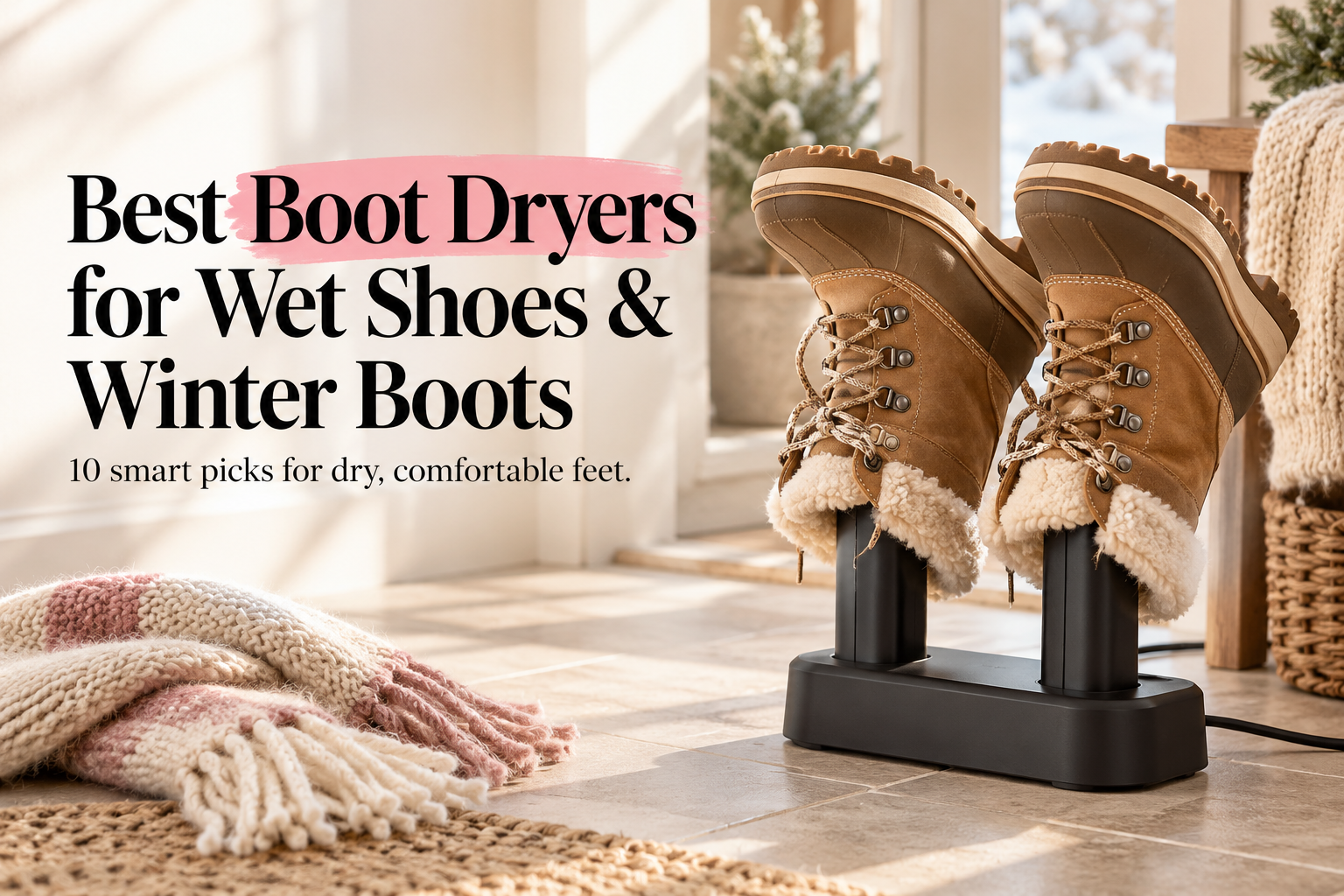
There are two kinds of winter mornings: the pleasantly organized ones, and the ones where you discover yesterday’s boots are still damp ten minutes before leaving. The second kind tends to involve a lot of sighing, frantic sock changes, and a questionable decision to put your feet back into something that feels like a chilled sponge. A boot dryer is one of those unglamorous tools that can quietly fix a surprisingly annoying daily problem.
But shopping for the best boot dryer is more complicated than buying whichever black plastic tower appears first. Some machines work gently and silently overnight; others circulate air more aggressively and are designed for shorter drying windows. Certain designs take one pair, while multi-port models can tackle gloves, cleats or a family pile of boots. Materials matter, too: insulated snow boots, leather work boots and delicate footwear are not interchangeable.
This guide compares ten identifiable Amazon models and, more importantly, explains how to choose the right kind of dryer for what actually gets wet in your home. It is based on manufacturer descriptions, independent published testing and marketplace research—not a claim that we personally tested every machine. You do not need ten dryers. You need the one that fits your wet-boot problem, your schedule and your space.
If boots can dry overnight, a quiet convection model such as the PEET Original is a sensible starting point. If you need the same boots again within a few hours, look at a forced-air dryer with a timer. For households juggling several pairs, a four-port unit usually makes more sense than buying multiple single-pair machines.
Convection vs. Forced-Air Boot Dryers: Which Is Better?
Think of a convection dryer as the relaxed, quietly competent person in the room. It uses gentle warmth to encourage air movement inside footwear, often without a fan. That makes it useful for overnight routines, bedrooms or shared spaces where mechanical noise would be unwelcome. Its trade-off is patience: a severely soaked boot can take much longer than a merely sweaty one, and the actual drying time depends on insulation, airflow and ambient humidity.
A forced-air boot dryer uses a fan to push air through the footwear. It may also include a heating element, selectable no-heat mode, timer or extended tubes for tall boots. Moving air can make a dramatic difference when water has reached the toe box or a thick lining, but airflow isn’t a license to ignore the care tag. Manufacturers sometimes specify particular temperature ranges; your footwear’s instructions take priority over sweeping “safe for all materials” claims.
The PEET Original is appealing because it does one job without adding an entire control panel to your life. Its tall posts direct gentle air upward into one pair of inverted shoes or boots. For someone who comes home at six and needs the same work boots by seven the next morning, the slow-and-steady approach may be exactly right. If you come home at noon and need dry cleats at two, however, a convection dryer is the wrong tool for that specific deadline.
Before you buy any dryer, separate damp from sweat from soaked by rain or snow. Damp footwear needs moisture management. Soaking-wet footwear often benefits from removing loose water first, taking out removable insoles and opening the shoe as widely as practical. Even a good machine performs better when the boot isn’t holding a literal puddle. Follow the appliance’s operating instructions and place it on a suitable dry, ventilated surface—not buried under coats in a cluttered closet.
The biggest beginner mistake is expecting every model to dry at the same speed. Published one-to-three-hour claims are usually conditional, not a stopwatch guarantee. A lightweight sneaker and a tall insulated hunting boot differ in thickness, ventilation, saturation and the amount of water trapped between layers. Treat advertised drying time as a comparison aid, not a promise that every pair will be ready before your next coffee break.

The Best Boot Dryer for Wet Work Boots Is the One You Can Actually Use Every Day
For work boots, repeatability matters more than flashy features. If you walk through mud, rain, concrete slurry or snow every shift, your dryer needs a routine that works when you are tired and busy. Put it in an accessible place, brush away excess dirt, loosen the laces, remove the insoles if the manufacturer allows it, and start the proper drying cycle as soon as you get home. Skip the fantasy where you will remember to do this three hours later.
Forced-air models become interesting when your boots are heavy, frequently saturated or needed twice in one day. The FORLIM’s adjustable drying ports are designed to reach farther inside different shoe shapes. That flexibility can matter more than raw wattage. More power does not automatically mean better for delicate liners or adhesive bonds; controlled airflow delivered to the right areas is the useful feature.
Keep an eye on the outsole and welt as well. The dryer addresses interior moisture but does not remove salt, grit or exterior residue. Wipe boots according to the maker’s care guide before drying. Leather pairs may need appropriate conditioning once clean and dry, while waterproof membranes call for additional care. Neither process should involve turning your favorite work boots into an improvised roast in front of a space heater.
The JobSite is a different answer to the same problem: it prioritizes quiet, simple overnight care instead of a short turnaround. That can be perfect if the footwear goes on the dryer after dinner and stays there until the morning. A low-fuss appliance is easier to use consistently than an elaborate machine whose timer you forget to set or whose controls end up behind a storage basket.
Don’t assume a “deodorizer” in a product title sterilizes footwear. Odor is influenced by accumulated sweat, microbes and material care; drying reduces lingering moisture but is not a substitute for cleaning when shoes are genuinely dirty. A machine without a chemical treatment or documented germ-killing test should not be described as disinfecting your boots. For stubborn odor, clean washable components according to the footwear manufacturer’s advice and allow them to dry separately.
Likewise, resist the temptation to put a soaked pair directly on a floor vent or hot radiator. Extreme heat can be hard on some footwear materials and adhesives. A dryer designed for footwear gives you a more intentional process, but it still has to be used with the correct settings, clearances and electrical safety precautions. Read the manual before leaving any unit running overnight.

Drying Two Pairs, Cleats and Gloves Without Creating a Mudroom Traffic Jam
If you have more than one person arriving home with wet gear, capacity becomes the real purchasing decision. A single-pair dryer can turn into an elaborate household scheduling issue: whose boots go first, who gets the morning slot, and why are there still four damp gloves on the countertop? A four-port dryer changes the math, especially when you can choose between two footwear pairs or a mix of footwear and compatible gloves.
The DryGuy Force Dry DX includes four ports and extensions suitable for taller boots. The manufacturer describes forced airflow, a heat/no-heat switch and a timed shutoff. That combination is particularly practical for ski weekends, sports practices or homes with multiple sets of damp outdoor gear. Just check that the physical ports and attachments fit your items. A glove needs airflow into the fingers, not merely warm air somewhere near its cuff.
Capacity isn’t everything, however. A four-port dryer uses counter or floor space, and fan noise may matter in a small apartment. Measure the location where the machine will sit and consider the cable route. If the outlet is across a walkway, solving wet boots by creating a trip hazard is not an upgrade. For home organization, place the dryer near a boot tray that captures snowmelt without blocking the unit’s intake or vents.
Portable Boot Dryers for Hotels, Ski Trips and Small Apartments
A portable dryer solves a different problem from a permanent mudroom station. On a winter vacation, you may have only one pair of snow boots, a cramped hotel room and another early start. A smaller in-shoe appliance can be worthwhile if its voltage, plug, size and power arrangement match the place you’ll use it. Do not assume a product sold for U.S. household outlets will work internationally without a compatible power solution.
The DryGuy Travel Dry DX is built around portability and offers AC/DC power options according to its manufacturer. That’s useful for certain car-based outings, provided you follow the equipment and vehicle power instructions. It is not the same as having a full-size household dryer with multiple glove ports, and the manufacturer expressly identifies limits on what can be dried with the travel design.
Travel accessories are easy to overbuy. If you ski once every five years, a dedicated travel dryer may not justify its space in your suitcase. If you regularly hike, camp or attend multi-day outdoor events, it might eliminate the unpleasant ritual of putting on yesterday’s wet shoes. Plan ahead: always let a dryer cool before packing it, and never run it inside a closed bag or under bedding.
The PEET Multi is more like a proper winter-gear station than a little shoe gadget. Its published configuration includes footwear ports and glove accessories, with quiet thermal-convection drying. That’s useful for homes where gloves and boots are the ongoing wet-weather issue, not occasional rain-soaked sneakers. Its larger base also demands a dedicated spot, so measure before imagining it fitting neatly between your umbrella stand and the door.
One overlooked issue with gloves is how much moisture hides inside the fingers. Hanging a glove by its cuff sometimes leaves the fingertips damp for hours. A compatible glove-drying attachment directs airflow through the interior. That doesn’t mean wool, leather or specialty waterproof gloves can all tolerate the same temperature; always check their labels and the dryer manufacturer’s compatibility instructions.
For households building a full winter entryway system, separate the jobs. Use a sturdy mat to catch tracked-in grit, a raised-edge tray for dripping boots, hooks or a rail for coats, and a dryer for the actual interior footwear moisture. This is also a good moment to inspect your drafty apartment door rather than letting winter weather take over the entire entrance. The best setup is one people will actually use after a long day.

Can You Use a Boot Dryer on Leather Boots, Sneakers and Waterproof Footwear?
Not every “shoe safe” claim deserves to be treated as universal. Leather, suede, neoprene, synthetic mesh, foam inserts, waterproof membranes and specialized adhesives can react differently to heat or prolonged drying. Start with the footwear label and any manufacturer guidance. When in doubt, choose a milder setting or unheated airflow and keep heat sources away from sensitive surfaces. A dryer should support your boots’ lifespan, not rush them toward a premature retirement.
For running shoes and everyday sneakers, remove washable or removable insoles where the manufacturer permits. Open up the tongue and loosen the laces so airflow can reach the inside. Clean excess mud separately rather than expecting warm air to solve everything. For leather, wipe away salt and water, then dry gently before applying any recommended care product. For ski boots, follow the liner and shell makers’ instructions, especially around custom-molded components.
Compact insert dryers such as the KOODER appeal to people who lack room for a standing unit. They may also reach the toe area differently. But insert-style heating requires a close reading of the manual: check insertion depth, shoe compatibility, operating temperature and whether the product needs to be unplugged between cycles. A tiny dryer can still be the wrong fit for an expensive or delicate shoe.
If two people regularly need footwear dry at the same time, the PEET Advantage Plus offers a clear distinction from the original single-pair model. It accommodates two pairs and uses a fan, with heated or unheated operation described by the manufacturer. The extra flexibility is appealing when one pair needs stronger airflow and another calls for a more cautious setting. It is not automatically worth the higher cost for someone who dries one pair overnight.
Pay attention to the difference between a choice you will use and a specification you just like reading. A no-heat mode is valuable if you have footwear that should not be warmed aggressively. A timer is valuable if you frequently forget to switch appliances off. Long tubes matter for tall boots. None of those features justifies a premium by itself if your household only needs quiet drying for regular low-cut shoes.
There’s also a running-cost perspective: a 36-watt appliance running for eight hours uses 0.288 kilowatt-hours of electricity. That is energy, not a price quote; multiply by your local rate to estimate operating cost. A higher-watt forced-air machine may run for a shorter period, so comparing wattage alone doesn’t tell you the total electricity used per drying cycle. The best purchase is the tool that fits your routine without wasteful operation.

Boot Dryer Buying Checklist: Five Things to Check Before You Pay
1. Drying deadline: Ask whether you’re dealing with overnight dampness or a rapid same-day turnaround. Quiet convection makes sense for the first. Faster forced air is more compelling for the second. 2. Capacity: Count pairs and compatible gloves, not merely the number of posts in the marketing photograph. 3. Footwear materials: Confirm whether the manufacturer explicitly supports your leather, synthetic, felt, neoprene or waterproof footwear.
4. Living space: Look at actual dimensions, cord length, storage footprint, sound and ventilation requirements. An apartment closet with no accessible outlet may not be a workable location. 5. Controls and warranty: Decide whether you need a timer, no-heat setting, automatic shutoff or longer protection. A long warranty may come with registration conditions, so read the current terms rather than assuming the retailer’s description is the whole policy.
The LAVIEAIR is another option in the quiet stand-style category. It’s worth comparing against the PEET and JobSite for current price, manufacturer support, form factor and exact features. We would not call one of those three “the absolute best” without testing them under the same wet conditions. Instead, choose based on usable differences: which fits your shoes, your noise tolerance, the amount of space available and the price you actually see at checkout.
Space-saving designs are especially tempting if you’re trying to keep a small apartment looking like a home instead of a ski-equipment warehouse. A foldable dryer such as the DR.PREPARE can be stored away when no longer needed, but folding arms and compact construction mean you should check whether bulky boots balance securely and whether the unit has enough clearance for airflow.
Also think about cleanability. Wet boots may drip dirty water onto a dryer, so keep the equipment off vulnerable surfaces and follow its cleaning instructions. Unplug a unit before maintenance, avoid immersing electrical components, and keep vents free from lint. A washable boot tray below or beside the station is often the least glamorous and most helpful companion purchase—even though it is not one of our ten dryer recommendations.
Don’t buy a machine on the promise that it permanently cures odor or replaces normal shoe care. Drying reduces moisture; it does not guarantee disinfection or rescue footwear that’s already deteriorating. Start with dry, clean socks, rotate shoes when possible, and wash or replace insoles only as the shoe maker recommends. Your dryer is a practical tool, not a magical forgiveness machine for the sneakers you last cleaned during a previous administration.
Editorial methods and limitations — October 30, 2026: Topic selection considered third-party Amazon search demand, published comparative tests from Bob Vila and product specifications from PEET and DryGuy. We cross-checked ten exact Amazon ASIN destinations; individual purchase availability, U.S. delivery eligibility and current checkout controls could not be independently established for every variant, so stock is not guaranteed. Product illustrations in the cards intentionally do not pretend to be exact Amazon product photographs. No hands-on testing is claimed. Published testing · DryGuy specifications · PEET specifications · Amazon marketplace demand estimate.








Leave a Reply