
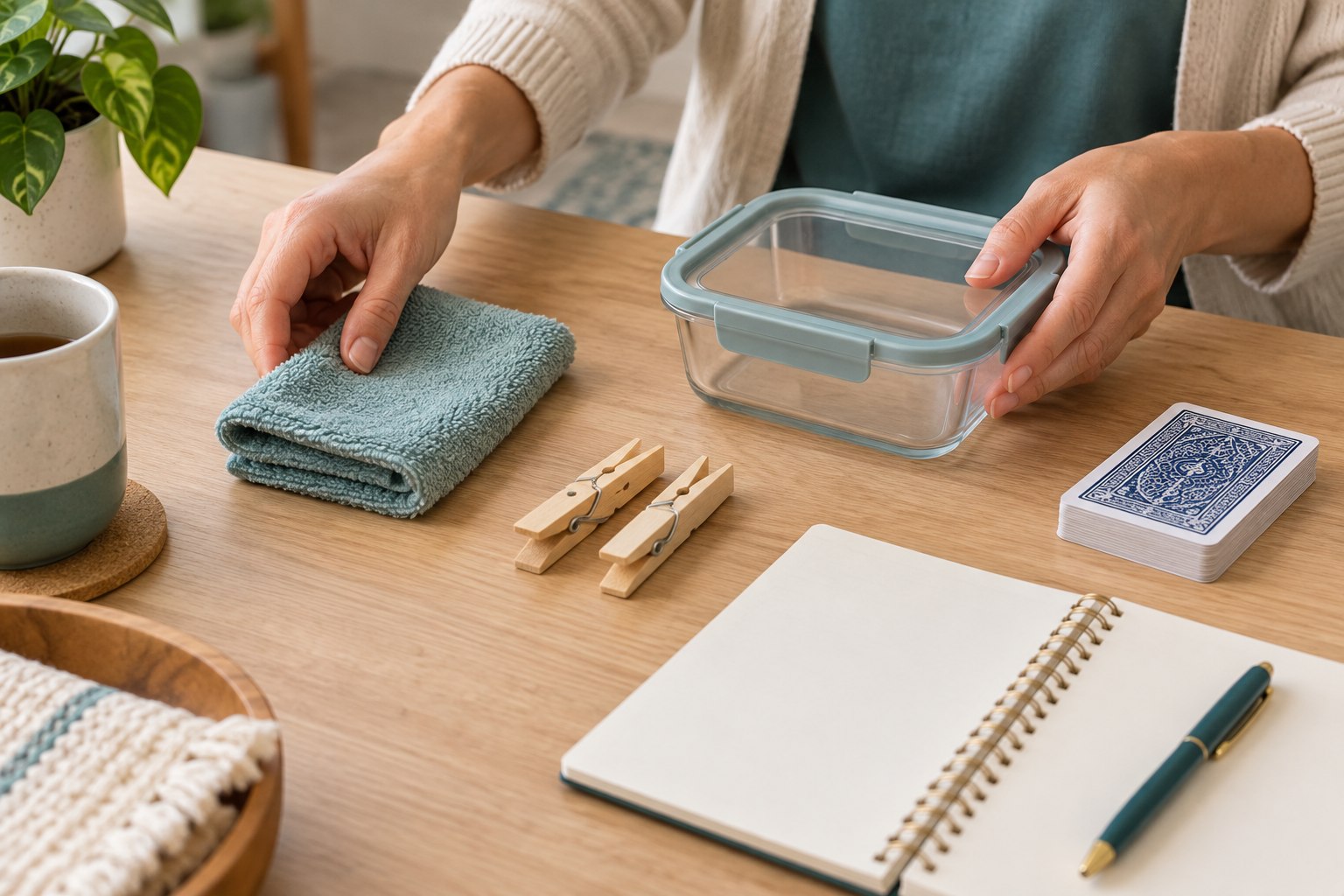
Looking for occupational therapy activity ideas that connect to everyday life without requiring a cart full of specialty supplies? Start with the client’s routine—and then check the cupboard. Towels, lunch containers, calendars, cards, and tote bags can become useful materials for planning meaningful activities.
The magic is not in the clothespin. It is in the clinical reasoning behind the activity. A clothespin has never attended a case conference, and frankly, its documentation would be terrible.
This guide gives OT practitioners and students 12 everyday-item activity ideas, practical ways to adjust task demands, observation prompts, and a free printable planning workbook. The examples lean toward adult daily routines, with suggestions for adapting the purpose to pediatric and school contexts.
Use these as educational planning examples selected through assessment, client preferences, and clinical judgment—not condition-specific treatment protocols or validated assessments. The editorial images illustrate materials and setups, not evidence of treatment outcomes.
Free printable: Everyday OT Activity Planning Workbook
Four useful pages: a reusable activity planner, an observation log, a fictional worked example, and a 12-idea reference menu. No email signup required.
Jump to: Start with purpose · Activity menu · 12 ideas · Adjust the challenge · Worked example · Printable PDF · FAQs
Start with a meaningful occupation, then choose the materials
Before choosing an OT activity, ask: “What does this person want or need to do in their actual life?” That question changes the session. Folding towels might matter to someone who wants to help with household laundry; for someone who never folds laundry and has no interest in starting, a different activity may be a better fit.
AOTA distinguishes everyday occupations from the activities practitioners select to support participation. Its occupations and everyday activities resource provides the professional context. The examples below are our own planning illustrations, not AOTA-endorsed activity protocols.
Use the AOTA occupational profile resource to support conversations about routines, interests, priorities, and context. A familiar object becomes more useful when it belongs to a task the client actually values.
- Priority: What daily activity matters to this client?
- Barrier: What part is difficult, inaccessible, tiring, or frustrating?
- Fit: Does this setup resemble the task, or is the connection only in our heads?
- Choice: Does the client want to try it, and what support do they prefer?
- Follow-through: How will we check whether it is useful in the actual routine?
Activity analysis means examining the demands of the task: its steps, objects, movement, attention, environment, timing, and social expectations. You can then change a demand intentionally rather than making the session busier and hoping that counts as progress.
Everyday occupational therapy activity ideas at a glance
| Everyday material | Possible meaningful task | A starting adjustment |
|---|---|---|
| Clothespins and clothing | Hang a laundry item | Change clip style or working position |
| Towels and washcloths | Fold and put away linens | Use a smaller item or visual model |
| Lunch containers | Pack and open lunch | Choose an accessible closure |
| Grocery packaging | Plan a pantry or shopping task | Reduce choices or add labels |
| Coins and a wallet | Prepare payment | Adjust denominations and prompts |
| Paper and envelopes | Prepare a personal card | Offer a template or preferred writing tool |
| Calendar | Plan an appointment | Use a simpler layout or reminders |
| Playing cards | Join a preferred game | Adjust rules or use a card holder |
| Tote and belongings | Pack for an outing | Use a client-approved checklist |
| Plant-care supplies | Look after a familiar plant | Use lighter tools or an accessible workspace |
| Clothing and hangers | Choose and organize an outfit | Offer fewer choices or easier hangers |
| Phone | Set a reminder or plan an outing | Use suitable accessibility settings |
ADL and IADL reminder: Dressing is an activity of daily living. Household management, meal preparation, shopping, and communication tasks can fall within instrumental activities of daily living. Leisure participation matters too. Choose the occupation and context first; not every useful session needs to look like a household chore marathon.
Optional materials: The product examples below are task-specific options, not a shopping checklist or clinically validated recommendations. Trial familiar household materials first. The practitioner’s assessment, client choice, and setting determine whether an item is suitable.
12 occupational therapy activity ideas using everyday items
1. Clothespins and clothing: make it an actual laundry task

Meaningful purpose: Hanging a washcloth, organizing clothing for drying, or helping with a familiar laundry routine. If squeezing clips is a preparatory activity, explain its connection to the occupation and check that connection rather than assuming transfer.
Set it up: Use a few clean clips, one lightweight laundry item, and a stable attachment point within an assessed accessible workspace. Start with the client’s preferred method when possible.
- Make it more accessible: Try a different clip design, fewer clips, a supported working position, or an easier-to-handle fabric.
- Explore a next challenge: Add a second familiar item or another step in the routine if appropriate. Reaching farther is not automatically the next step.
- Observe: How the person opens and places the clip, assistance needed, discomfort, pauses, and whether the setup feels useful.
Real-life check: Can the person use the chosen method at their own drying rack or laundry area? Account for pinch points, small parts, and any restrictions on grip or reaching.
2. Towels and washcloths: fold something worth putting away
Meaningful purpose: Contributing to household laundry, organizing a bathroom shelf, or completing a familiar work task. Folded towels have the satisfying advantage of being useful after the session. Very few therapy supplies can say the same.
Set it up: Offer one or two clean linens and a clear folding surface. Ask how the client usually folds them before demonstrating your preferred towel origami.
- Make it more accessible: Choose a smaller cloth, show a completed example, reduce the number of items, or adjust the surface and position.
- Explore a next challenge: Add sorting by destination, stacking, or putting the folded items away where appropriate.
- Observe: Initiation, the sequence used, corrections, assistance, effort, and the client’s satisfaction with the result.
Real-life check: Does the result fit the client’s storage space and routine? An unfamiliar “perfect” fold may be less useful than their own workable method.
3. Lunch containers: practice the lunch the person actually eats

Meaningful purpose: Packing lunch for work, school, volunteering, or an outing; opening the container when it is time to eat.
Set it up: Use a familiar bag and clean empty containers. Identify the actual barrier: selecting items, opening a lid, arranging the bag, remembering what is needed, or managing the routine.
- Make it more accessible: Try a compatible easier-opening container, a stable surface, a picture checklist, or fewer items.
- Explore a next challenge: Choose needed items from a slightly larger set or complete another relevant packing step.
- Observe: Steps completed, specific cues, physical assistance, closure management, self-checking, and client feedback.
Real-life check: Try the chosen strategy in the actual lunch routine with consent and appropriate support. If food enters the task, consider allergies, food hygiene, and any relevant eating or swallowing precautions.
When a familiar lunch lid is the actual barrier. A container purchase only makes sense if the closure suits the person’s real lunch routine. Trial the opening, closing, stabilizing, and packing steps first; an airtight lid is not automatically an accessible lid.

FOR THE LUNCH-PACKING EXAMPLE
Rubbermaid Brilliance 3.2-Cup Plastic Containers
This set provides clear containers with latching lids to compare against a familiar snap-on container. Use clean, empty containers for planning examples. Check pack size and dimensions, and assess whether the latches and seal increase or reduce the person’s task demands. Use their existing container if it works.
A small thank-you: this link supports our business.
4. Grocery packaging: put the pantry puzzle to work
Meaningful purpose: Building a shopping list, finding ingredients, identifying what needs replacing, or organizing groceries.
Set it up: Use clean empty packaging from familiar products and a client-selected task: “What do we need for this meal?” or “Where would these go at home?” Use labels that resemble the client’s actual environment when relevant.
- Make it more accessible: Present fewer choices, use a picture list, improve label visibility, or establish a clear starting point.
- Explore a next challenge: Compare quantities, identify a missing item, or plan within a fictional budget.
- Observe: Searching strategies, category choices, decisions, error recognition, and supports that help.
Real-life check: Revisit the actual pantry or shopping process. Literacy, language, vision, culture, and household preferences influence the task. A tidy display of pretend groceries does not establish safe independent shopping.
Make the pantry task include closing the bag again. If resealing a familiar bag is part of the client’s routine, clip design is one variable worth comparing. A kitchen clip offers a different opening surface from a narrow wooden clothespin; test rather than assuming it is easier.

FOR THE PANTRY-PACKAGING TASK
OXO Good Grips Magnetic All-Purpose Clips — 4 pack
An optional alternative for closing clean pantry packaging or holding a chosen checklist. Observe opening, placement, and removal in the actual task. These are household clips, not calibrated resistance or assessment tools. Check suitability, pinch points, and small-part or magnet risks for the individual and setting.
A small thank-you: this link supports our business.
5. Coins and a wallet: connect money handling to a purchase

Meaningful purpose: Preparing payment for a familiar purchase, finding a travel card, or organizing a wallet.
Set it up: Choose one fictional purchase or wallet task. Use suitable practice money or client-approved materials. The goal might involve accessing the wallet, selecting payment, or checking the transaction—not doing arithmetic for its own sake.
- Make it more accessible: Reduce denominations, use clearly marked prices, organize wallet sections, or offer a written sequence.
- Explore a next challenge: Add another item or a relevant change-checking step, with accurate materials.
- Observe: Selection, handling, cueing, calculation strategy when relevant, and checking for errors.
Real-life check: Consider the actual payment method and environment. Small objects may be inappropriate for clients at ingestion risk. Practice performance does not establish financial decision-making capacity.
6. Paper, envelopes, and a pen: give writing a reason
Meaningful purpose: Sending a card, writing a shopping note, labeling belongings, or preparing a message for someone important.
Set it up: Let the client choose the message and format. Offer their preferred writing tool, appropriate surface, blank card, and envelope if mailing is part of the task.
- Make it more accessible: Provide a message template, larger writing area, stable paper, or an assessed alternative tool or input method.
- Explore a next challenge: Add the address, envelope preparation, or another chosen step.
- Observe: Legibility for the intended purpose, effort, endurance, organization, assistance, and comfort.
Real-life check: Could the person use this method for their own message? An alternative such as voice input or a typed card may better support participation. The assignment is communication, not winning a penmanship pageant.
Choose the writing tool around the message. If writing a chosen card is uncomfortable or difficult, an OT may trial a different pen shape alongside positioning, paper stabilization, or another input method. Buying a special pen is useful only if that trial supports the person’s own communication goal.

FOR AN INDIVIDUALIZED WRITING-TOOL TRIAL
PenAgain ErgoSof Pen — Blue
The distinctive Y-shaped barrel offers an alternative finger-support arrangement to compare with a conventional pen. Check fit, ink and refill details, control, and comfort during the actual writing task. It is not a universal solution for a diagnosis; typing, voice input, or a familiar pen may be a better choice.
A small thank-you: this link supports our business.
7. A calendar: plan one appointment that matters
Meaningful purpose: Keeping track of a chosen appointment, social event, routine, or deadline.
Set it up: Begin with the person’s preferred paper or digital calendar and one fictional event. Identify what makes the process difficult: finding the date, entering information, reading the layout, or remembering to check it.
- Make it more accessible: Simplify the view, enlarge text, reduce visible information, or agree on a useful reminder.
- Explore a next challenge: Add a second event or a realistic scheduling conflict if relevant.
- Observe: Information entry, date selection, checking strategies, prompts, and whether the person can find the event later.
Real-life check: Follow up on actual use. A beautifully filled calendar that lives unopened in a drawer has excellent stationery energy and limited practical value.
8. Playing cards: leisure belongs in the plan
Meaningful purpose: Joining a game the person enjoys, spending time with friends, or returning to a familiar hobby.
Set it up: Ask what they like to play, with whom, and what has become difficult. Card handling, seeing the cards, following turns, seating, or the social environment may each need different supports.
- Make it more accessible: Use a card holder, larger-print cards, fewer cards, simplified agreed rules, or an accessible table arrangement.
- Explore a next challenge: Add a preferred game step or social component without sacrificing enjoyment.
- Observe: Participation, turn-taking, access to materials, assistance, enjoyment, frustration, and choice.
Real-life check: Does the adaptation work with the person’s usual group or preferred version of the game? Sorting cards can be a component activity; it is not automatically equivalent to participating in game night.
If seeing the card corners is what interrupts game night. Larger corner markings can be worth trying when standard indices are hard to read. Keep the person’s preferred game and group in mind; changing the cards should support their leisure participation, not create a new task they did not choose.

FOR RETURNING TO A PREFERRED CARD GAME
Bicycle Jumbo Index Playing Cards — 2 pack
Standard poker-size decks with larger indices, rather than physically oversized novelty cards. Compare visibility, contrast, and handling with the person’s existing deck. A card holder or different layout may address a separate access barrier; larger print alone does not solve every difficulty.
A small thank-you: this link supports our business.
9. A tote bag: pack for a real outing

Meaningful purpose: Getting ready for work, a community outing, a class, or a visit.
Set it up: Choose an outing with the client. Gather a small set of relevant belongings and agree on a checklist. Use an accessible packing surface and the bag they are likely to use.
- Make it more accessible: Place needed items together, use a picture list, reduce choices, or select a bag with easier access.
- Explore a next challenge: Select needed items from a slightly larger set or add a final self-check.
- Observe: Organization, item selection, sequence, checklist use, prompts, and ability to access the packed belongings.
Real-life check: Try the actual departure routine where appropriate. Respect lifting and carrying limits; packing a bag does not mean the client should carry it. Keep valuables and private information out of demonstration setups.
10. Plant-care supplies: make the activity personal
Meaningful purpose: Caring for a familiar plant, tending a garden, or continuing a valued household role.
Set it up: Choose a plant the person enjoys and one manageable task, such as planning its care, wiping suitable leaves, or watering with an appropriate amount.
- Make it more accessible: Use lightweight tools, an accessible working height, fewer steps, or planned breaks.
- Explore a next challenge: Add another relevant care step or a simple reminder system.
- Observe: Planning, tool use, pacing, access, assistance, and whether the task is enjoyable.
Real-life check: Does the setup resemble the person’s actual plant area? Consider plant toxicity, allergies, soil exposure, sanitation requirements, water spills, and tool hazards. A paper planning version may be preferable in some settings.
Match the watering tool to the plant and the person. A smaller can can offer a different task setup from a large garden can, but water still adds weight. Trial it with an assessed amount, at a suitable height, and in the person’s own plant-care space where practical.

FOR A MEANINGFUL PLANT-CARE ROUTINE
Haws Handy Plastic Indoor Watering Can — Green
A small plastic watering can with a long spout and removable rose for comparing plant-care methods. Start with a manageable fill and check grasp, reach, pouring control, and cleanup. Verify dimensions and capacity on the listing; a familiar cup or paper care-planning task may suit the goal better.
A small thank-you: this link supports our business.
11. Clothing and hangers: plan the outfit and the access
Meaningful purpose: Choosing clothes for the day, organizing a wardrobe, or preparing for a meaningful event.
Set it up: Offer familiar clothing and a client-chosen context. Ask about preferred styles and routines. Clothing selection and wardrobe organization are different demands from putting the clothing on; be clear which task you are addressing.
- Make it more accessible: Reduce choices, use easier hanger designs, present items within reach, or organize by the person’s preferred categories.
- Explore a next challenge: Add a weather or occasion consideration, or another relevant organizing step.
- Observe: Choice-making, handling, access, sequence, assistance, comfort, and personal preference.
Real-life check: Try the actual wardrobe arrangement when appropriate. Keep clothing age-respectful and personally relevant. Nobody needs a therapy session that quietly becomes a makeover they did not request.
12. A phone: use the tool already in the routine
Meaningful purpose: Setting a reminder, communicating with someone, checking an outing plan, or finding information needed for a daily task.
Set it up: Agree on one task and the preferred device. Use fictional information for demonstration. Ask permission before changing settings; start with a feature that supports the selected task.
- Make it more accessible: Explore appropriate text size, voice input, a written sequence, or a simpler route through the interface.
- Explore a next challenge: Add a follow-up action, such as finding the saved reminder or checking the planned destination.
- Observe: Navigation, error recovery, prompts, access, and whether the person can repeat the chosen process.
Real-life check: Can the person use the strategy when the need occurs? Protect personal information and avoid entering passwords, banking details, or private health information into practice demonstrations.
How to grade an OT activity without turning it into an obstacle course
Grading an activity means adjusting its demands to fit the person and purpose. Making a task more accessible can be the most useful intervention choice. An adaptation the client can use every day is not a consolation prize.
| Demand to consider | More accessible starting point | Possible next variation |
|---|---|---|
| Number of steps | One relevant step or a clear sequence | Add another task step |
| Choices | Only the needed items | A few additional realistic options |
| Objects | Familiar, manageable materials | A relevant variation in the actual routine |
| Environment | Clear layout and suitable access | Usual context, when appropriate |
| Instructions | Agreed verbal, visual, or written supports | Test whether the preferred support remains useful |
| Duration | Shorter task or planned breaks | Another meaningful step if tolerated and wanted |
Change one demand at a time when you want an interpretable comparison. Changing the container, instructions, position, and time limit all at once makes it hard to know what helped—or what made the task less accessible.
Avoid adding speed, standing, heavier loads, or extra reaching simply because they make the task harder. Those changes need a reason and appropriate assessment. Participation is the goal; difficulty is one adjustable variable.
What to observe: useful details beyond “did well”
“Did well” is pleasant. It is also about as specific as “the weather happened.” Record details that another practitioner—and your future self—can interpret:
- What task, materials, position, and supports were used?
- How many planned steps were completed?
- What type and number of cues were provided?
- Was setup help or physical assistance needed, and for which part?
- Did the client notice and correct errors?
- What did they report about effort, discomfort, fatigue, enjoyment, or frustration?
- What changed, and what will be checked in the actual routine?
Define your assistance and cueing terms rather than treating them as universally identical. Timing may be useful when it relates to the task, but faster completion is not always the desired outcome.
AOTA’s intervention outcomes resource supports collaborating on meaningful outcomes and selecting appropriate measures. Our worksheet is a reflection and planning tool; it does not replace a validated outcome measure or your workplace documentation requirements.
A worked example: lunch packing with a purpose
Fictional client priority: “I want to pack my lunch for my volunteer shift.” This example illustrates planning, not a treatment recommendation for a diagnosis.
- Choose the actual routine: Identify the bag, containers, steps, and supports the client usually uses.
- Create a manageable setup: Begin with a familiar bag, two clean empty containers, and a client-approved picture checklist.
- Agree on support: Clarify when prompts or physical help will be offered.
- Observe: For example: “Completed three of four planned steps with the picture list visible and one verbal cue to check the bag; opened the selected lids without physical assistance.”
- Adjust: If selecting items is the next relevant challenge, add a small number of choices while keeping other conditions consistent.
- Follow through: With consent and suitable support, check the actual morning routine. Is the checklist still useful with usual distractions and available time?
That final check matters. A simulated success gives you information about that setup; it does not prove independent performance at home.
Pediatric and school-based OT: adapt the purpose, not just the object
The same supplies can fit different routines. A lunch container may be relevant to managing school lunch; a tote may become a school-bag packing task; a calendar may help plan a chosen classroom responsibility. Start with the child’s participation priorities, family context, school demands, and appropriate consent or assent.
Keep examples age-respectful. A teenager may prefer planning belongings for a club meeting over an activity that feels designed for a much younger child. Likewise, an adult should not receive childlike materials simply because they need cognitive or physical support.
Consider choking and ingestion risk with clips, coins, and other small parts. Materials that work in one setting may be unsuitable in another. Familiarity and low cost do not automatically make an item safe.
Download the free printable OT activity planning workbook
This four-page occupational therapy activity-planning PDF turns the ideas into something you can actually use. It is designed for printing on US Letter paper, with clear writing space and restrained color accents.
- Page 1: Plan the client priority, real-life task, materials, setup, assistance, grading, and observable success.
- Page 2: Record starting conditions, observations across attempts, client response, and the next real-world check.
- Page 3: See the completed fictional lunch-packing example.
- Page 4: Keep all 12 ideas and professional reference links together.

Free printable: Everyday OT Activity Planning Workbook
Four useful pages: a reusable activity planner, an observation log, a fictional worked example, and a 12-idea reference menu. No email signup required.
How to use it: Print only the page you need, choose one meaningful task, and fill in the starting conditions before the activity. Afterwards, add what happened and one next step. Use a nonidentifying reference and follow workplace policies for clinical records.
Professional OT resources to keep nearby
For evidence and professional guidance, start with these AOTA resources. Some linked materials or downloads may require membership or purchase; check access on the destination page.
- Occupations and everyday activities — the professional context for selecting activities connected to participation.
- Occupational profile resource — a starting point for exploring client routines and priorities.
- Practice Smart recommendations — guidance on purposeful practice and avoiding approaches unsupported by evidence.
- Intervention outcomes — considerations for meaningful outcomes and appropriate measures.
- Practice guidelines and evidence-based clinical resources — condition- and topic-specific guidance to inform professional decisions.
Frequently asked questions about everyday OT activities
What are occupation-based occupational therapy activities?
They involve occupations meaningful to the client, such as getting dressed, preparing a lunch, organizing a routine, or joining a preferred leisure activity. A component task can support that occupation, but the relationship should be explicit and checked.
Can household items replace specialized therapy equipment?
Sometimes ordinary materials suit the selected task very well. They do not replace every assessment, intervention tool, or safety support. Choose equipment according to the person, setting, task demands, and evidence—not the price tag alone.
Are these fine motor activities for adults?
Some examples involve manipulating lids, cards, clips, pens, and clothing. Their usefulness depends on the client’s real-life goal. This is not a universal hand-strengthening program; loading, resistance, and repetitive practice require appropriate assessment.
Can these ideas be used for executive functioning activities?
Planning, sequencing, selecting items, and checking results appear in several examples. Pick a relevant routine, identify the barrier, and test supports in that context. Completing a calendar task does not establish improvement across all executive functioning demands.
Can caregivers use the printable as a home program?
The workbook is written as a planning aid for practitioners and students. A caregiver can contribute observations or priorities, but the activity, precautions, assistance, and home-use instructions should be individualized by the treating professional.
Is the printable a standardized assessment?
No. It is an original educational planner and observation log created by Catching Print Co. It has not been validated or clinically reviewed and is not endorsed by AOTA. Use appropriate standardized tools and professional documentation systems where required.
Try one useful activity before building twelve elaborate stations
Choose one client priority, gather familiar materials, identify a manageable starting point, and decide what you will observe. Then check the actual task. That is a more useful starting point than turning a table into an escape room made entirely of pantry containers.
Low-cost supplies can be convenient. Meaningful purpose, thoughtful adaptation, and the client’s own experience are what make the plan worth keeping.
A small nod to the people who notice the small wins
Opening a lunch container, getting a card ready to send, or leaving home with the right belongings can matter a great deal to the person doing it. Our design celebrates that everyday progress: “Small Wins. Big Impact.” occupational therapy design.

If that message feels like your kind of workday reminder, you can see the OT shirt and sweatshirt here, including the optional personalized version.
And whether or not it ends up in your wardrobe, the free workbook is yours to use. Sometimes the small win is simply having a plan ready before the next session.
As an Amazon Associate I earn from qualifying purchases. Thank you for supporting Catching Print Co.







Leave a Reply